In a new example of just how much we’re learning about our fascinating deep seas, researchers have announced the discovery of the first known hydrothermal vents in the Doldrums Megatransform and Fracture Zone.
Located around 800 miles off the coast of Brazil, just north of the equator, this region of the Atlantic Ocean intersects the Mid-Atlantic Ridge: the longest mountain range on the planet.
Because of its tectonic activity, the Doldrums Fracture Zone is full of bizarre organisms that have adapted to live in these harsh, deep waters. Many of these lifeforms are unlike anything we know on land.
“Here, tectonic plates scrape and slide past one another, creating fascinating geologic formations like fault scarps and sedimented basins, both of which can host areas of chemically altered seawater and deep-sea ecosystems,” writes Schmidt Ocean Institute on its website.
When researchers spent more than one month exploring the mid-Atlantic, their remotely operated vehicle (ROV) SuBastian stumbled upon something they weren’t expecting: two rare types of hydrothermal vent fields in and around the Doldrums.
Hydrothermal vents are known along the Mid-Atlantic Ridge but this is the first time they’ve ever been observed in the Doldrums.
“This discovery shows why exploration still matters,” says the expedition’s chief scientist, Dr. Aaron Micallef, a scientist at MBARI (Monterey Bay Aquarium Research Institute) in a press release. “Even in the Atlantic Ocean, where plate boundaries have been studied for decades, there are still places where the first close look can reveal something entirely new.”
One of the two fields was gigantic: around 24 acres – the equivalent of 14 football fields – and made up of 23 hydrothermal vents. 13 of those had active black smokers: hot vents that spew out dark smoke like a burning building (as opposed to white smokers, which are cooler and spit out paler steam-like streams). When scientists measured the fluids coming from the vents, they found them to be an almost unimaginable 280 degrees Celsius.
Despite this, there was plenty of life, including anemones, crabs, and thousands of blind Rimicaris shrimp. Because there is no light so far below the surface, the creatures that live down here get their energy from chemicals from the vents rather than sunlight.
In the video released by Schmidt Ocean Institute, the camera pans across strange landscapes, like something out of a sci-fi movie, with plumes of water shimmering from the heat of the vents.
The scientists think a rare process called serpentinization is happening on both of these newly discovered vent fields. “Serpentinisation is a process in which seawater reacts with minerals in rocks, producing heat and chemical energy that allow life to thrive in the deep ocean without sunlight,” says Dr. Jyotika Virmani, executive director of Schmidt Ocean Institute. “A better understanding of these systems could provide clues for finding life on other planets.”
“We arrived searching for vents, faults, and seamounts,” adds Dr. Paula Zapata Ramirez, assistant professor at the Universidad Pontificia Bolivariana. “We leave with something even more valuable: a deeper understanding of ecosystems in one of the least explored regions of the Atlantic Ocean.”
During the month-long expedition, the researchers also came across several beguiling deep-sea weirdos, including two bigfin squids (Magnapinna sp.) – whose tentacles can reach up to eight metres long and trail through the water like unruly cotton spilling from its spool – and the baffling barreleye fish whose strange, tubular eyes can be seen through its translucent skull. The barreleye species they recorded – Winteria telescope – has never been caught on film before.
“Every sample, every image, and every discovery brings us one step closer to understanding the hidden parts of our planet,” says Zapata Ramirez
These wonderful surprises reveal glimpses of how much we have yet to learn about our deep seas. “This expedition showed that even in one of the most remote corners of the ocean, our planet remains alive, dynamic, and full of surprises,” says Micallef.
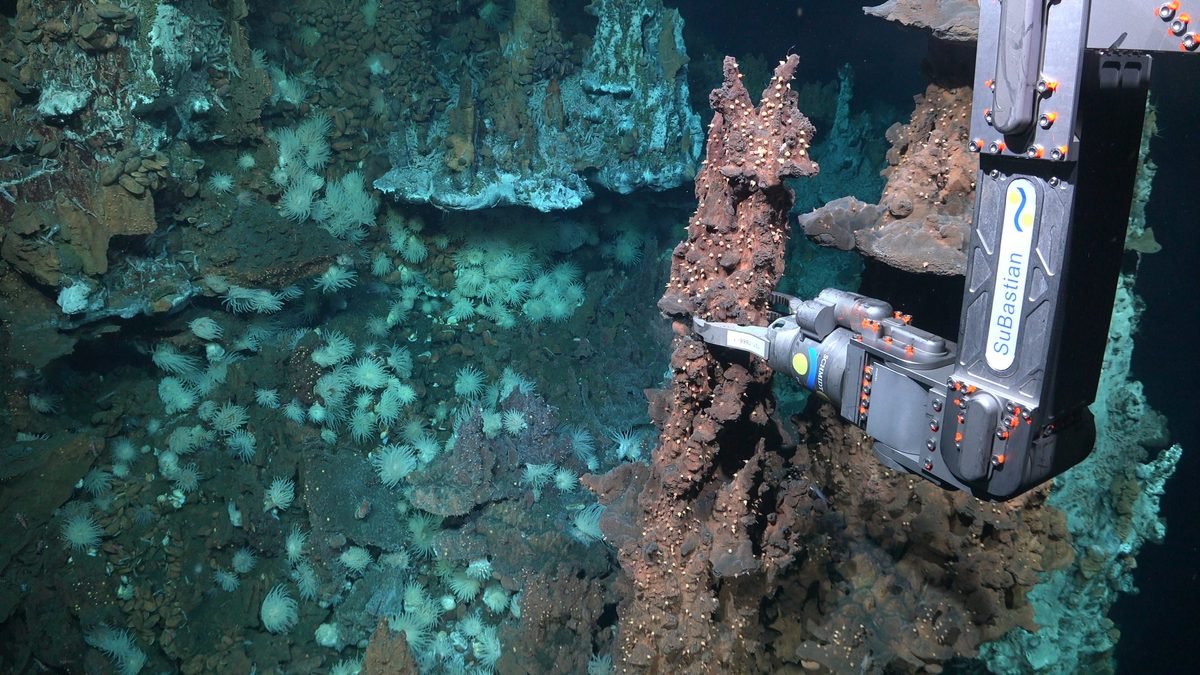
Top image: ROV SuBastian pilots collect a geologic sample from a hydrothermal vent chimney nearly 3,890 meters (2.4 miles) deep. Scientists discovered two new hydrothermal vent fields in one of the least explored areas of the Atlantic Ocean, the Doldrums Megatransform and Fracture Zone.
This large, tectonically active system cuts across the Mid-Atlantic Ridge, which forms the world’s longest mountain chain. These types of vent fields are rare because of their hybrid “plumbing” systems, featuring typical volcanic venting alongside serpentinization, a chemical reaction that occurs when rocks from the Earth’s mantle are exposed to seawater.
Photo Credit: ROV SuBastian / Schmidt Ocean Institute
Video credit: Schmidt Ocean Institute
Discover more from News Link360
Subscribe to get the latest posts sent to your email.