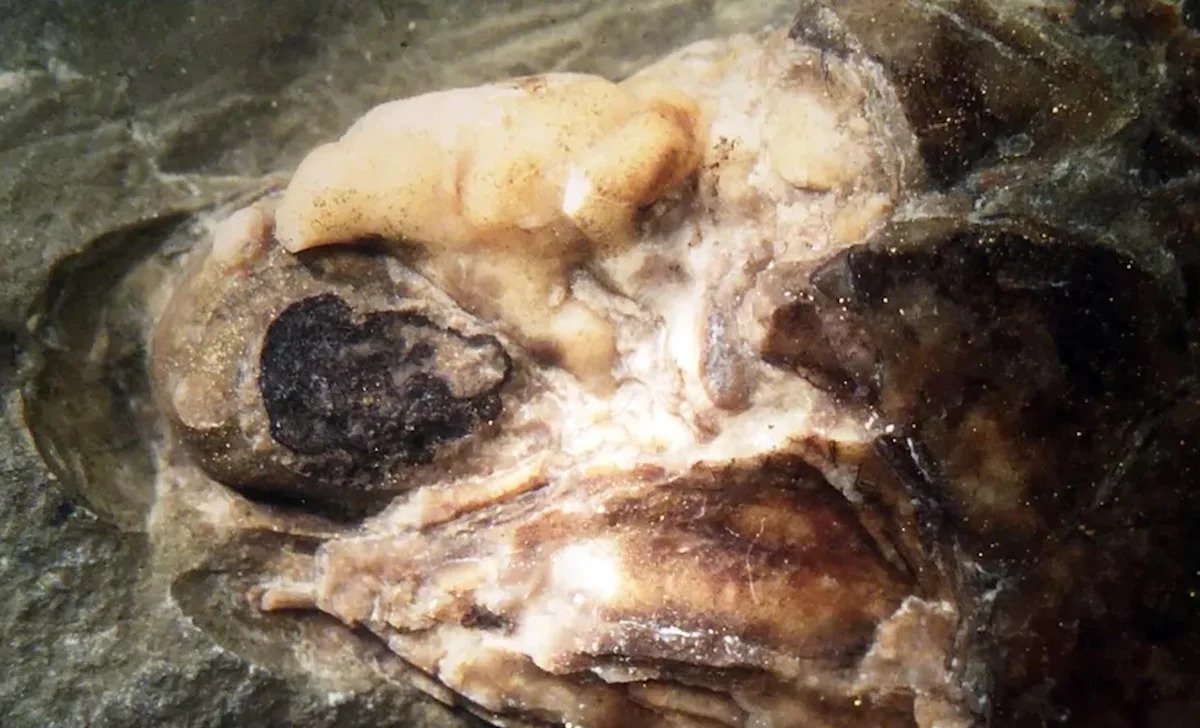
Fossils almost never preserve brains, which is why a tiny fish from roughly 300 million years ago is drawing so much scientific attention.
Sealed in soapstone and found near Trawden in Lancashire, U.K., the specimen is offering researchers new clues about how some early fish brains were arranged inside their skulls.
What happened?
What sets this fossil apart is the soft tissue still present inside the skull. The fish, Trawdenia planti, lived during the Carboniferous period and was discovered near Trawden in the U.K., but unlike most fossils, it retained brain tissue that would ordinarily decay long before fossilization, IFLScience reported.
The specimen also followed an unusual path into the scientific record. It was found in the late 1800s inside a rounded rock nodule that had been split, and the two pieces were later cataloged at London’s Natural History Museum as separate specimens.
Once researchers recognized that the two pieces matched, they reunited them and examined the fossil with CT scans and 3D modeling. That let them investigate both the skull and the preserved soft tissues inside it without damaging the specimen.
Results published in PNAS pointed to an unexpected feature. Rather than showing a brain much smaller than the cavity around it, as many previously studied fossil fish seemed to do, T. planti appears to have had a brain that fit closely within its braincase.
Why does it matter?
Findings like this can reshape how scientists read the fossil record. Bones and teeth are preserved far more often than soft tissues, and neural tissue is especially fragile. As a result, many ancient animals have been understood mostly through their hard parts, leaving major gaps in scientists’ understanding of how their bodies actually functioned.
Lead author Abigail Caron and senior author Michael Coates used the specimen to test assumptions drawn from older fossils. In many fossil fish, it had appeared as though the brain sat inside a much larger skull cavity.
This fish suggests the picture may be more complicated. Rather than relative size alone telling the full story, the arrangement of tissues inside the skull may matter more. That could influence how paleontologists reconstruct the anatomy of other extinct species from partial remains.
Museum collections can still yield major scientific breakthroughs. Fossils gathered generations ago may produce new answers when modern imaging tools are applied.
What’s being done?
In this case, the biggest step forward came from reexamining an old specimen with new technology. CT scanning and digital 3D reconstruction enabled scientists to study the braincase in detail while preserving the fossil.
That approach is becoming increasingly important for museums and researchers. Collections around the world hold countless specimens gathered long before today’s imaging methods existed, and some may preserve hidden features that were impossible to detect when they were first found.
Discoveries do not always come from new digs; sometimes they come from looking again, more carefully, at what was already sitting on a shelf.
Get TCD’s free newsletters for easy tips, smart advice, and a chance to earn $5,000 toward home upgrades. To see more stories like this one, change your Google preferences here.
Discover more from News Link360
Subscribe to get the latest posts sent to your email.