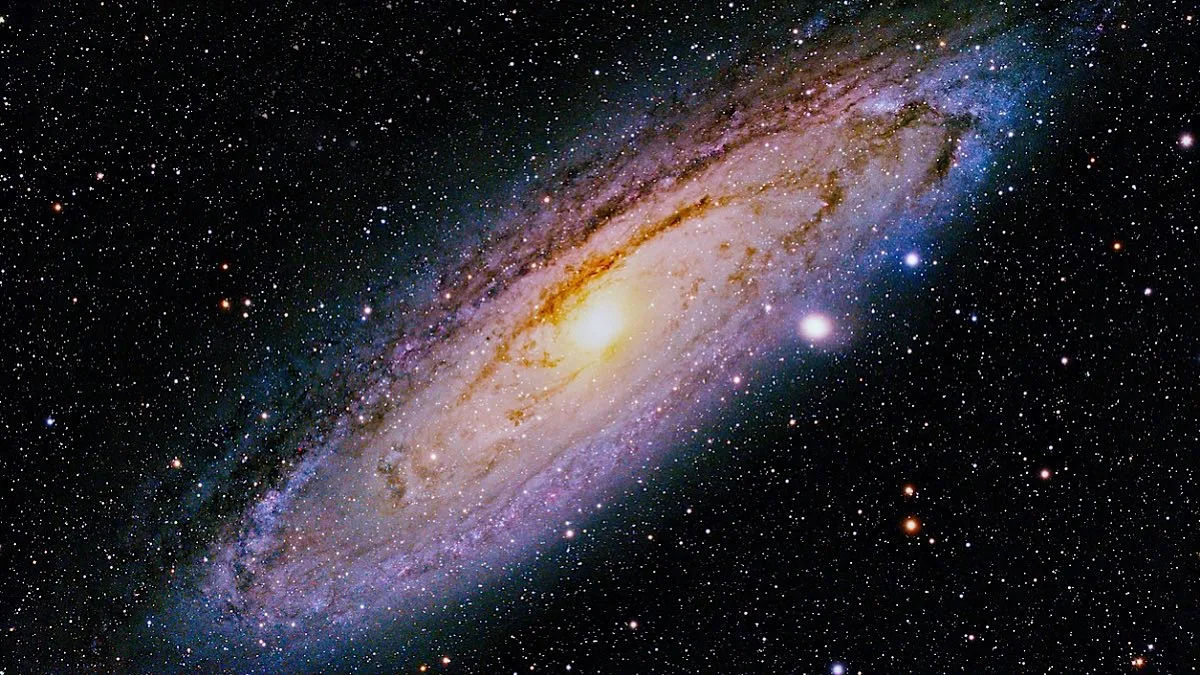
Astronomers believe that this discovery can change the long-held perception of the formation of galaxies after the Big Bang. Until now, it was thought that the galaxies that formed at the beginning of the universe were messy and chaotic; the volume and mass were much less. From there, we had to wait many billions of years to become the spiral galaxy we know. However, researchers at the National Centre of Radio Astrophysics-TIFR (NCRA-TIFR) in Pune, Rashi Jain and Yogesh Wadadekar, while analyzing data from the JWST, suggest something different.
Advertisement
Peering into the universe’s distant past, they discover a well-formed giant spiral galaxy, as beautiful and well-organized as a cosmic spiral. Earlier this year, they discovered the galaxy. The study was recently published in the Journal of Astronomy and Astrophysics. JWST is very popular in the world of astronomy, especially for detecting the first stars and galaxies that emerged a few hundred million years after the Big Bang. The space research organizations of the United States, Europe, and Canada, collectively spending about 10 billion, put this state-of-the-art telescope into space in 2021.
Since its inception, astronomy has been discovering new and distant galaxies. At first, the images released by NASA showed many blurry spots, but now JWST is taking many clear pictures, exposing the complex structures of space to scientists. Rashi, a leading researcher of these findings, said that she came across this galaxy while looking at the images and data sent by James Webb. “I was analyzing the data of about 70,000 celestial objects. Only one of them was such a large, well-formed, and mature spiral galaxy. Its diameter is about 30,000 light-years“.
To achieve this, they use a 2D fitting algorithm called GALFIT. The galaxy is situated near Abell 2744, a massive galaxy cluster whose massive gravitational pull acts as a magnifying glass, bending and magnifying the light from distant celestial bodies. In physics, this effect is known as gravitational lensing. This makes the Alaknanda appear twice as bright, making JWST’s task easier. The JWST has 21 filters that perfectly capture Alaknanda. In this galaxy, the constellations are arranged like a string of beads, similar to those in our well-known Milky Way, among other examples.
At first, her supervisor, Professor Wadadekar, did not want to believe Rashi’s words: finding the existence of a massive spiral galaxy formed within just 1.5 billion years of the Big Bang is a stirring event in the world of astronomy. This galaxy, one-third the size of our Milky Way, contains stars equal to the mass of about one billion suns, as well as small and large stars of different masses; in such a short time (in terms of the cosmological timeline), this enormous number is astounding. Scientists say there are around 10 billion galaxies in the universe. Many began to form in the first few million years after the Big Bang.
But Alaknanda is a little different from the others. In this galaxy, stars are forming at a far faster rate than in the others. Our Milky Way makes roughly 1–2 solar masses (1 M☉ ~ 1030 kg) of stars every year, but Alaknanda makes 63 M☉ stars every year. This means that the pace of star creation is about 30 times higher! In the first 200 million years, half of the stars in this galaxy were born. Actually, its existence forces astronomers to rethink how quickly order and structure emerged in the early cosmos. It takes a long time for light from a cosmic structure to reach us, so when we see them in the telescope, we get a much earlier image, which astrophysicists claim to have seen, in fact, 1200 million years ago. Some galaxies are so long that it is impossible to see from beginning to end. That’s why scientists emphasize statistical analysis. WHAT IS
THE CURRENT STATE OF ALAKNANDA ?
Physicists know that it is not possible to answer this question in any way today, because it will take 12 billion years for light to reach the earth from the state where Alaknanda is now. Based on data from telescopes other than James Webb’s, physicists should then investigate how the spiral arms of this galaxy were formed, how they rotate around its center, etc. Various cosmological structures have been discovered throughout the years, thanks to Hubble, JWST, and other modern telescopes, but this discovery by two Indian researchers shows the world that cosmological discoveries are no longer the exclusive domain of large observatories.
(THE AUTHOR IS A RESEARCHER AND FREELANCE SCIENCE WRITER)
Discover more from News Link360
Subscribe to get the latest posts sent to your email.