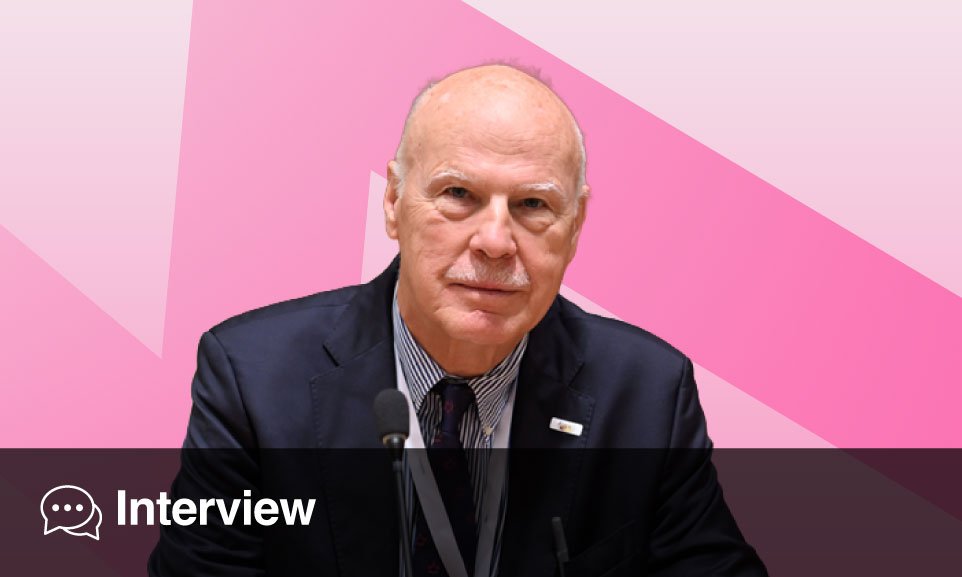
Wolfgang Grisold | Former President, World Federation of Neurology (WFN); Steering Committee and Programme Committee, International Congress of Neuromuscular Disease (ICNMD)
Citation: EMJ Neurol. 2026; https://doi.org/10.33590/emjneurol/7097860A

As a member of both the International Congress of Neuromuscular Disease (ICNMD) Steering Committee and Programme Committee, you helped shape this year’s Congress. Looking back now that it has concluded, which themes or discussions do you think most clearly captured where neuromuscular medicine is heading?
The purpose of the ICNMD, which is part of the World Federation of Neurology (WFN), is to foster and promote neuromuscular disease. Over the years, there have been 19 or 20 congresses. The traditional way for the congress to approach this is to try to tackle all four parts of the neuromuscular system: muscle, nerve, neuromuscular transmission, and motor neurone diseases.
The structure of the Congress is that, for each day, we have a specific topic with plenary sessions, scientific sessions, and, for the first time, we also tried to carefully mix topics for the afternoon sessions. In addition to those scientific sessions, the WFN is always very keen on education, teaching, and neurology worldwide. The meeting provided a good atmosphere for lectures and teaching, with a lot of discussions in corridors and over coffee breaks. We also had teaching courses, 15 in total. Some of them were extremely successful, such as the electrophysiology and electromyography course, and the ultrasound course on peripheral nerves. This shows that the trend toward offering more hands-on courses in the future is very important.
Where is neuromuscular medicine heading?
I think that, over the years, it was a discipline that was very pr. Then came a major advance, which is continuing, through the of autoimmune mechanisms. Myasthenia is one of the paradigmatic examples, as are several neuropathies and several myopathies. This is continuing as new drugs and new substances become available. I think one enormous impact is genetics. Genetics and molecular medicine are becoming increasingly important and change the fate of persons affected.
Another example is interdisciplinary aspects, such as leprosy and infectious diseases, cancer, and side effects of immune checkpoint inhibitors and CAR-T cells, which are challenging because they involve the whole neuromuscular system to a certain extent.
It is important to bring this knowledge to the community. For example, in oncology, if patients have side effects like numb feet or numb hands, this may not be a major concern for the oncologist, but it is for the patient because they may not be able to use their hands or walk properly. This is very important to consider. So, bringing this knowledge to the community and increasing awareness of neuromuscular medicine is important.
You chaired the session ‘Ageing and Senescence’, which explored sarcopenia, cachexia, and age-related changes in peripheral nerve function. What do you think was the most important message to emerge from those discussions for practising neurologists?
I think the most important message is that we even had such a session, because it was not on the agenda previously. I opened the session by saying that we know so much about muscle and nerve, but we know little about human ageing. We know that normal values change, conduction velocity changes, and maybe other parameters change as well, but we do not have a comprehensive view.
There was a keynote lecture from a basic scientist on the topic of senescence, on what senescence is, how it can possibly be changed, and what it means in various parts of the body, not only in nerves but in all kinds of cells.
The second lecture was by Claudia Sommer, University of Würzburg, Germany, who is the incoming President of the Peripheral Nerve Society (PNS). She spoke about peripheral nerve ageing and presented very interesting and important findings. As you know, there is a neuropathy called chronic idiopathic axonal neuropathy, affecting people from around 50 years onwards who have a mild neuropathy. It does not progress, but nobody really knows what is happening. We also have the major aspect of diabetes, which is often associated with neuropathy. A large proportion of the world’s population, with increasing numbers, is affected by diabetes, so this is of major importance. Of course, ageing is also important in regard to genetic diseases and other diseases. I think it is also important regarding sensitivity to drugs or side effects.
The third lecture was about sarcopenia. There are three terms. One is sarcopenia, which means that an otherwise healthy individual, usually an older individual, loses muscle volume. This is interesting because more and more people are looking at it, and you can assess it easily with a hand grip and numerical values of the diameter of muscles. My preference is to palpate the temporal muscle or the thigh. Then you can assess, when you look at the individual, whether there is enough muscle there. There is also something called adipose sarcopenia, which means that people still have volume in the thigh, but it is usually fat and not muscle, so this can also help.
The second term is cachexia. Cachexia is a very old term, and it describes how people with cancer lose weight. They do not only lose strength, but they lose weight and muscle volume; they have protein loss, and this is a very well-known phenomenon. Everybody knows that if somebody has advanced cancer, they lose these features. These two terms seem to be very much connected with another term, which is frailty. Frailty means that you are unstable on your legs, and frailty and sarcopenia have a very close relationship. People who do not train and who do not walk become frail. If they are frail, they fall, and they have problems. So, this is very mechanistic.
The session also highlighted growing evidence linking sarcopenia with cognitive decline. How convincing do you find that association, and what does it tell us about the relationship between muscle health and brain health in ageing?
The exciting thing is that there are now some studies trying to find a link between muscle, myokines, and potential messenger molecules, and . This is important and may also be a stimulating area for the future if this link can be established. There are studies exploring a cross-talk between muscle and brain, and this could be important for cognitive health. There are also other very interesting connections that are related but not the same, such as adiposity. There appears to be a connection between adiposity and cognition as well.
Many presentations at ICNMD 2026 showcased advances in genetics, biomarkers, and targeted therapies. What do you think remains the biggest obstacle to translating these scientific advances into routine clinical care?
I think there is one simple explanation: money and expenses. If I look from the perspective of the World Federation of Neurology (WFN), the income of countries determines what is possible. There is perhaps some hope that the WHO may also help with the so-called Essential Medicines List, a list that is freely downloadable on the website and gives recommendations worldwide on drugs that every country should have. There is nothing about muscle diseases, except for myasthenia. Of course, these treatments are more expensive, but recommending them internationally could make a difference.
That means that whatever we discuss here, if you put this into the context of the global population, we are speaking for the few percent who will be able to afford these drugs in the future. So, that is a very important point.
Throughout your career with the WFN, you have championed global neurological education and access to care. After the discussions at this year’s Congress, what do you see as the greatest challenge in ensuring that advances in neuromuscular medicine benefit patients equitably around the world?
I think education is definitely the spearhead, because if educated neurologists are aware of neuromuscular problems, they will advocate doing something for the patients. They may not do it immediately, and they may not do it on a large scale, but the better we are with neuromuscular disease, the better it is.
You may know that the WFN has a few training centres in Africa. This means we train some people through full-time, 1-year fellowships. In this regard, we have one neuromuscular training centre in Rabat, Morocco, that is financed by the ICNMD Congresses. We have been doing this for about 10 years. Right now, we have a trainee from Mali, West Africa, whom I introduced at the opening session. They spend 1 year receiving highly qualified training in nerve conduction studies and electromyography, and they can then return to their country and start something because, in many African countries, there is little available. This will definitely be followed by laboratory testing, biomarkers, and genetics, but that is a large step. Some African centres can do this, but compared with the large areas of Africa or some Asian regions, it is not enough.
Regarding the prevalence of neuromuscular disease worldwide, the robustness of the data varies. For example, in countries in Northern Africa, I would say the prevalence and incidence estimates can be taken seriously. For other regions, the estimates appear to be low, but in my opinion, and I cannot prove this, this is likely a statistical issue because they do not have the necessary tools and resources for accurate assessment.
The Global Burden of Disease Study, which is a worldwide study by the Gates Foundation, Seattle, Washington, USA, has really made a difference regarding the assessment of the number of diseases and the number of people affected. However, the method was to have pilots or pioneers in some countries, so this is not fully representative. Really obtaining data from Africa would need official bodies. As an example, when I was investigating neurological structures for the WHO in Austria a few years ago, there were three sources: the Chamber of Physicians, the Ministry, and the Society of Neurology. I was acting on behalf of the Society, and there were three different figures, like three different countries. Epidemiology is important and needs to have reliable sources. Although it seems boring, based on epidemiological data you can allocate funds and allocate resources. The Global Burden of Disease Study includes neuromuscular disease, but not enough. After many interventions, it has now included diabetic neuropathy. But there is practically no muscle disease and no real survey on that. So, I think this will need improvement.
Looking across the entire programme, which development presented at ICNMD 2026 do you think is most likely to change neuromuscular practice over the next 5 years?
Genetic examinations are currently highly specialised and very specific. Because of this, they are practically not usable for many parts of the world. There seems to be a tendency that many geneticists are working on more commonly applicable genetic tests that would be easily implemented in many parts of the world. That was one of the key points that I realised. From the immune side, I think there is highly stimulating development of new drugs because, for autoimmune diseases, we have more or less relied on immunoglobulin, steroids, and plasmapheresis. This has dramatically evolved into Fc receptor inhibitors and other drugs that work on different mechanisms and from different angles.
From the interdisciplinary work, the reverse information for neurology from cancer drugs, in particular, the new checkpoint inhibitors and cancer therapies, is immense and will also influence neurological therapies. It is important that people increasingly look for solid biomarkers. One biomarker is creatine kinase, which is a very rough but very valuable biomarker, and I think we need more.
We also had another interesting interdisciplinary session on peripheral nerves with the German Nerve Club. This is a rather small multidisciplinary society of German neurosurgeons, neurologists, basic scientists, and neuropathologists who are very much involved in surgical interventions and, through that, regeneration of the nervous system. They do excellent research work regarding sensory nerves of the face. If people lose the innervation of the cornea of the eye, they develop ulcers. With surgical procedures, one can re-innervate. So, the practical use of surgical interventions for patients with severe sensory deficits is very important. We had a joint session with this society for the first time, and that was very interesting because it is an interdisciplinary area that is used every day, but not so many people know about. I think that is also one of the highlights.
We also had a joint session with the WFN, called the ICNMD World Federation session. We covered what happened to people after COVID-19, including 15 databases comprising 15 million people that we analysed from databases. We also had a fascinating lecture about leprosy, which is an ongoing story in Brazil and other parts of the world.
There were, of course, industrial sponsors who organised many excellent industry sessions, and although these were not accredited, they usually featured outstanding speakers.
The event itself was accredited for Continuing Medical Education (EACCME), meaning that it followed a strict accreditation system recognised in Europe and North America.
Another important thing is that, before the Congress, following the tradition of ICNMD, we had a patient day. This means that, together with our Italian colleagues, we invited Italian patient organisations. There were 15 representatives who gave short overviews of their organisations, followed by six Italian professors who gave overviews in Italian on muscle and nerve disorders, what was happening at the Congress, what was new, and what was in the pipeline in regard to therapy.
Discover more from News Link360
Subscribe to get the latest posts sent to your email.