Al Jazeera has received a copy of Thursday’s agreement, which stipulates that the precise disarmament roadmap must be prepared within 14 days, with possible extensions subject to the approval of an international verification body, and the agreement of all parties.
Recommended Stories
list of 3 itemsend of list
“These negotiations were difficult and hard, and we tried to reach the best possible formula that was achievable,” Ghazi Hamad, a member of Hamas’s negotiating delegation, told Al Jazeera.
However, Hamad said that Hamas would not implement any part of the agreement if Israeli forces failed to fulfil their obligations. The official said disarmament depended on Israel’s withdrawal from Gaza and progress on reconstruction in the Palestinian territory.
There has been no comment yet from Israel.
Trump framed the agreement as a success for the Board of Peace, the body established to oversee Gaza’s governance.
“This agreement is a critical step towards Gaza finally being governed by a new Palestinian government that will work closely with the Board of Peace to help the Palestinian people,” Trump wrote on his Truth Social platform on Thursday. “At the same time, Israel will have the security it deserves, with Gaza no longer used as a base for terror attacks.”
The copy of the agreement obtained by Al Jazeera says that the disarmament process will begin with the entry of a National Committee and the International Stabilisation Force to Gaza. The National Committee will then oversee the “inventory and storage” process, with the international verification committee observing, and the Palestinian factions participating.
The disarmament process is also tied to the gradual withdrawal of Israeli forces from Gaza. It also adds that no weapons should be handed over to Israel or any non-Palestinian body, and that the National Committee be the sole force holding on to the weapons in Gaza.
A Board of Peace official confirmed to Al Jazeera that Hamas and other armed factions would hand over their weapons to a National Committee set to administer Gaza. The official said weapons held by the police would be transferred first, followed by the decommissioning of heavy weapons. All military activity in Gaza would have to stop under the plan, though the official said the process will take time to implement.
Nickolay Mladenov, the Board of Peace’s high representative for Gaza, said it “took months of very difficult negotiations” for the agreement to be reached.
“There were several points when I did not believe we would make it,” he wrote on X on Friday, adding that what happens next “matters even more” than the initial deal.
“Implementation and verification have to be real,” Mladenov said. “Withdrawal must move in lockstep with decommissioning.”
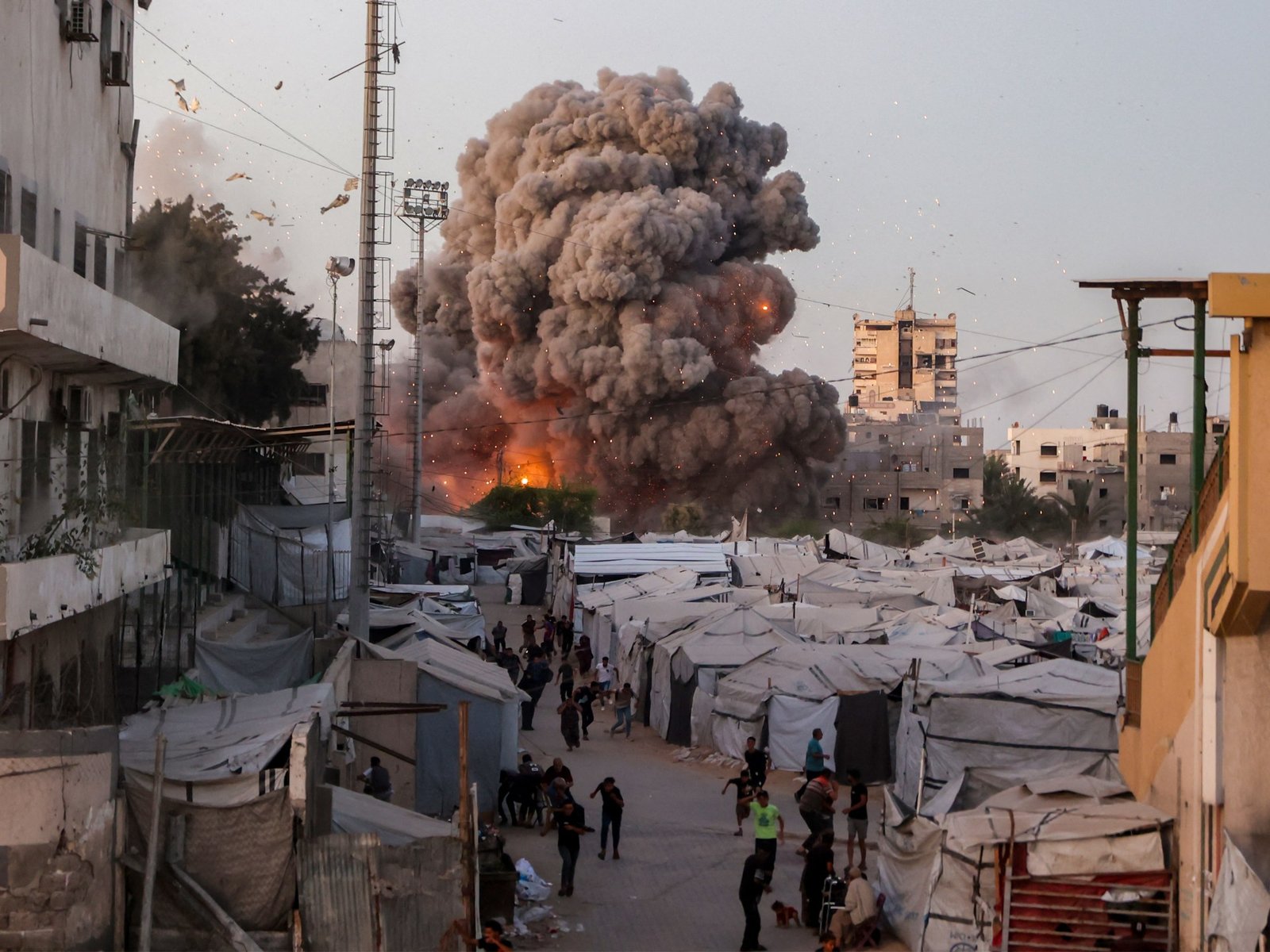
Trump framed the disarmament – which he said would take place in phases – as part of the “ceasefire” deal he brokered in October to end Israel’s genocidal war on Gaza, which has killed more than 73,000 Palestinians and devastated the Palestinian enclave.
Israel has repeatedly violated the ceasefire, killing more than 1,200 Palestinians since it came into effect, seizing more territory, and continuing to restrict the movement of people and goods into and out of Gaza. Six more Palestinians were killed in Israeli attacks on Gaza on Thursday, including two children.
Trump said Israel would withdraw from Gaza and be replaced by an International Stabilization Force working with a “new Palestinian police force” once disarmament was complete.
“Under this agreement, Gaza will finally be in the hands of a new Palestinian government that serves its PEOPLE,” Trump added.
Hamas leaders have been in the Egyptian capital, Cairo, since late last week discussing the ceasefire deal with mediators from Egypt, Qatar, and Turkiye. An unnamed Hamas official was quoted earlier on Thursday as saying that the talks were “positive” and “making progress”.
Egypt will soon host more talks in Cairo involving mediators from Egypt, the US, Qatar and Turkiye to secure commitments to the second phase of the ceasefire roadmap, according to Egypt’s A-Qahera News. The broadcaster, citing an informed Egyptian source, said Hamas and other Palestinian factions had officially approved the proposal, which includes the deployment of international forces and the start of work by the National Committee.
However, Palestinian Islamic Jihad, another armed group in Gaza, said reports of an agreement between the factions and Israel were inaccurate, adding that it had reservations about the wording being circulated.
Hamas had announced on July 6 the dissolution of the body it led that had governed Gaza for nearly two decades.
Al Jazeera’s Alan Fisher, reporting from Washington, DC, said that the arrangement would see Hamas and other groups disarm sector by sector, followed by the recruitment of more Palestinian police officers.
“[The Palestinian police will] be working in association with an international coordination force, the makeup of which has yet to be cleared, but we’ve heard rumours that it could involve the Indonesians and possibly even the Turks, something the Israelis might not be keen on,” Fisher said.
Fisher said there were some obstacles to getting all sides to sign the agreement, but it was made clear things would get a lot more difficult for Hamas financially if it did not approve the deal.
“There was definitely international pressure on Hamas to accept this,” Fisher said.
Nidal Abu Zaid, a military analyst, told Al Jazeera that the focus of the agreement on the phrase “inventory and storage” was subtly different to “disarmament”.
“From a military standpoint… Inventory and storage is carried out by a third party, but that party does not need to be an enemy force,” Abu Zaid said. “But disarmament is carried out by an enemy force, and [the Palestinian factions] will never agree to that disarmament.”
Earlier, a US official told reporters that there was much Israeli criticism when Turkiye and Qatar were invited to join the Board of Peace, but that the agreement had proven that including the countries was the right decision.
“I think, right now, there is finally an alternative to the PA [Palestinian Authority] and Hamas”, which is a “technocratic, apolitical government that is really looking to do this for the benefit of the people”, he said.
Discover more from News Link360
Subscribe to get the latest posts sent to your email.