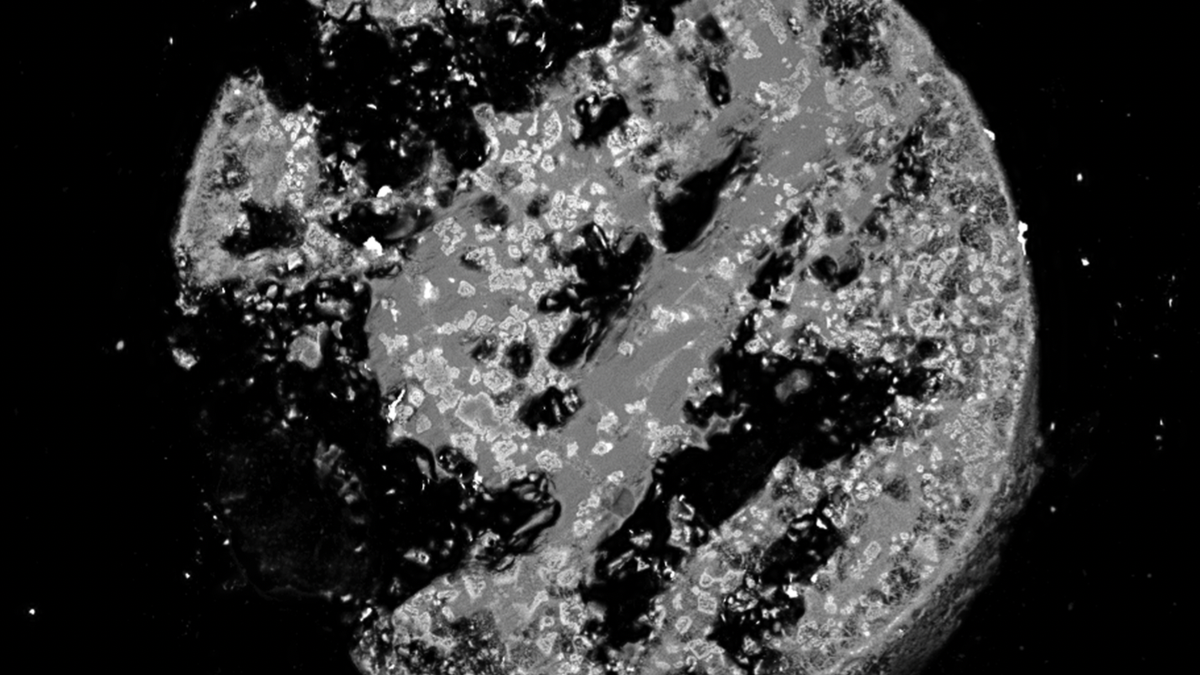

Back-scattered electron image taken with a scanning electron microscope of the spheroidal hiroshimaite sample in which the allow was found.
| Photo Credit: Bindi et al., Sci. Adv. 12, eaeg8299 (2026)
When the researchers examined the beads, they identified a micrometer-sized metallic grain embedded in the glass. It turned out to be a complex mix of iron, chromium, nickel, manganese, molybdenum, silicon, and aluminium — and it had a unique crystal structure.
The findings were published in Science Advances on July 29.
The team has expressed belief that the alloy formed by ultrafast quenching: the explosion’s fireball reached temperatures over 7,000° C, turning urban materials such as construction steel and aluminium into a mixed metallic vapour. As the fireball expanded and rapidly cooled, the elements mixed in a way that is impossible under normal conditions, stabilising into their final, complex phase.
According to the researchers, their work shows that high-energy plasma events like nuclear detonations can be natural laboratories where scientists can discover new materials that are difficult to synthesise in a scientific lab. The alloy already shares characteristics with other unusual high-entropy alloys and quasicrystals, which are of great interest among engineers for their strength and stability.
The researchers also wrote that their work shows how debris can preserve a “high-resolution record” of the chemical and physical environment during a nuclear event.
Published – August 02, 2026 12:30 pm IST
Discover more from News Link360
Subscribe to get the latest posts sent to your email.