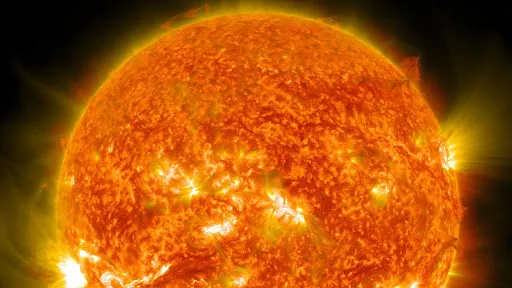
Researchers have discovered that the thousands of thin, jet-like structures seen emanating from the Sun’s surface may be a trick of perspective. For decades, scientists have observed spicules, towering columns of plasma that shoot upward from the Sun’s surface, and wondered why they appeared to spin like tiny tornadoes. New research published in The Astrophysical Journal reveals that these jets are not necessarily individual tubes but rather folds within massive, sheet-like plasma curtains that ripple through the solar atmosphere.



The study, led by researchers from the Indian Institute of Astrophysics and the University of Sheffield, UK, used complex three-dimensional computer simulations to model the Sun’s atmosphere. By recreating the chaotic environment where the Sun’s visible surface meets its outer atmosphere, the team found that what appears to be a forest of individual spinning straws is actually the result of viewing multiple layers of a warped, pleated curtain of hot gas. When these folds overlap from our point of view on Earth, they create the illusion of concentrated, rotating cylinders.
This discovery provides a breakthrough in our understanding of the solar chromosphere, the layer of the Sun’s atmosphere that sits just above its visible surface. Spicules are a vital part of this layer, carrying heat and matter from the interior out into the corona, the Sun’s million-degree outer atmosphere. Understanding how they move is essential to solving the coronal heating problem: the mystery of why the Sun’s outer atmosphere is hundreds of times hotter than its surface.
The researchers found that slow-moving waves triggered by the Sun’s internal churning launch the spicules. As these waves travel upward, they sharpen into powerful shocks, similar to a sonic boom, which kick the plasma toward the sky. However, instead of forming a neat tube, the plasma organises into fluted, sheet-like structures. The simulation showed that these curtains develop large density differences at their edges. These density differences, combined with the tension of the Sun’s magnetic field lines, generate swirling motions known as vortices.
The researchers identified two distinct types of these Coronal Swirling Conduits. The first type is driven by magnetic tension, where the magnetic field itself twists and pulls the plasma into a swirl. The second type is baroclinic, meaning it is driven by a mismatch between the pressure and the density of the gas at the edges of the spicule curtains. Both types of swirls allow energy to flow upward into the corona, but they do so by interacting with the curtain-like folds of the plasma rather than spinning a single isolated jet.
While earlier models could explain how the plasma was lifted, they struggled to explain the complex sideways and rotational motions captured by modern telescopes. By moving to a three-dimensional radiative magnetohydrodynamic (rMHD) simulation, the team replicated the exact interbraiding and splitting of jets seen in real-world data from the Hinode and IRIS space observatories.
The researchers, however, noted that while their simulation captured the physics of how these structures form, real spicules on the Sun tend to last longer and show more complex braiding than the computer models. This suggests that the Sun may have more rotational energy or longer-lived magnetic conduits than current simulations can fully account for. Scientists believe this may be due to the Sun’s immense scale compared to the specific slice of the atmosphere captured in the computer model.
Understanding the Sun’s atmosphere is the key to discerning space weather. When the Sun’s magnetic fields snap or release energy through structures like spicules and vortices, they can trigger solar storms that hurtle toward Earth. These storms can knock out satellite communications, disrupt GPS systems, and even cause massive failures in our electrical power grids. By finally understanding the true 3D shape and rotational mechanics of solar spicules, scientists are better equipped to predict how energy moves through the Sun’s atmosphere, ultimately helping us protect the technological infrastructure that modern society relies on every day.