
150 Years of Vande Mataram: Why India is still debating the freedom song


“Vande Mataram” is not just a song to many Indians. It is memory. It is school assemblies. It is the sound of a crowded hall rising to its feet. It is a phrase that, for generations, has carried a rush of emotion that is hard to explain but easy to feel.
And yet, the same words can trigger arguments. Why should a line that once united people now divide timelines?
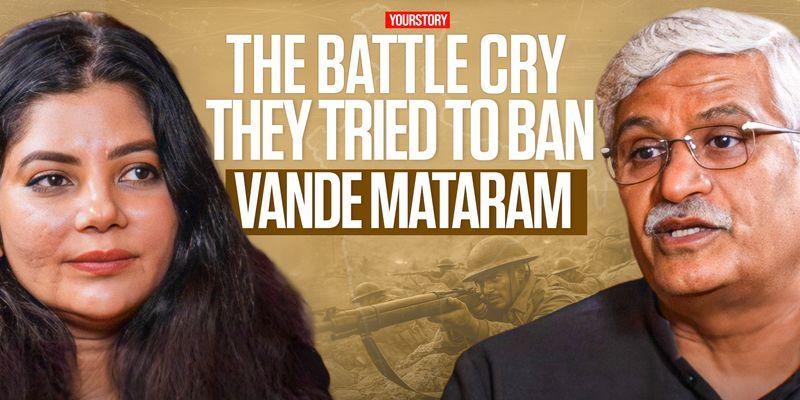
This is the question that shaped a recent conversation on the 150-year milestone of “Vande Mataram”, with Union minister Gajendra Singh Shekhawat joining the discussion. The minister’s opening note was not about controversy. It was about history. His point was simple: you cannot understand the present noise unless you understand where the song came from, and what it meant in the years when India did not have a flag of its own.
A song born from collapse, meant to rebuild courage
The minister took the listener back to the emotional wreckage that followed the failure of the 1857 uprising against British rule. In his telling, the defeat was not only military. It created a psychological rupture. People lost faith, not just in victory, but in their own ability to resist.
<div class="externalHtml embed active" contenteditable="false" data-val="” align=”center”>
It is in this atmosphere, he said, that Bankim Chandra Chattopadhyay wrote “Vande Mataram”, imagining India as a mother, a living presence, not a territory under occupation. That idea mattered. It gave the freedom movement a language of devotion, and a single emotional thread that could run across provinces, organisations, and strategies.
The minister described how the song first appeared in print in Bangadarshan and later became widely known through Anandamath, where it travelled beyond the page and into the bloodstream of the independence movement.
Over time, translations and adaptations carried it into multiple Indian languages. “Vande Mataram” stopped being a literary creation. It became a public greeting, a shared declaration, a shorthand for belonging.
The slogan that met sacrifice
In the minister’s narrative, the power of “Vande Mataram” is inseparable from martyrdom. He invoked the image of freedom fighters approaching the gallows, calling the song their final words. The point was not to build a list of names, but to underline what the phrase came to represent, a willingness to pay the highest price.
Those who fought British rule, he said, used “Vande Mataram” the way movements use a rallying cry. When people met each other in the struggle, it became a salutation. It carried a sense of duty, and a sense of shared purpose.
That is why, he argued, the song’s meaning cannot be reduced to a modern-day argument about who should say it and who should not. In the freedom movement, it was less a slogan and more a bond.
The controversy, and the politics around it
If the first half of the minister’s account was about unity, the second half was about fracture. He blamed political decisions in the late 1930s for weakening the song’s position in public life, describing it as a moment when Congress “surrendered” under pressure from the Muslim League, and linked that shift to a wider breakdown that culminated in Partition. In his view, the debate over “Vande Mataram” was not merely cultural. It became political, and then it became symbolic of a deeper divide.
Not everyone will accept that framing, and the minister’s version is clearly a pointed political reading of history. But it captures something true about the present: “Vande Mataram” is rarely discussed today as music alone. It is discussed as identity, as memory, as power, and sometimes as a test of nationalism.
That is why social media polarises so quickly on the issue. People are not only debating a song. They are debating who gets to define the nation.
A constitutional compromise, and an unresolved emotion
The minister also referred to the moment when the Constituent Assembly, under the leadership of Dr Rajendra Prasad, recognised “Vande Mataram” and “Jana Gana Mana” with an assurance of comparable respect. It was a balancing act: honour the emotional force of one, and the formal role of the other.
That balancing act still shapes India’s public life. It is why “Vande Mataram” can feel like a sacred inheritance to some, and complicated to others. The language of the song, including its imagery of the motherland as a goddess, produces deep reverence for many listeners. The minister spoke about the “full swaroop” of the song, and how a proper rendition can stir even the most indifferent heart.
But the same imagery can become the centre of disagreement when people read it through different cultural and political lenses. The gap between devotion and discomfort is where today’s controversy lives.
Culture beyond religion, and the idea of India as many-in-one
One of the most important threads in the conversation moved away from the song itself and towards a larger claim: India’s culture cannot be reduced to religion alone.
The minister described Indian culture as multi-coloured and multi-layered, shaped by thousands of practices, cuisines, costumes, languages, and local traditions. He offered the example of the Hornbill Festival in Nagaland, with many tribes presenting distinct cultural identities, as a reminder that India’s “one-ness” has never meant sameness.
His argument was that India may not have always existed as one political entity, but it has long carried a sense of civilisational continuity. He used references ranging from Shankaracharya’s travels to the shared experience of pilgrimage as examples of a cultural thread that cuts across region and language.
In this framing, “Vande Mataram” becomes one symbol among many that point to the same idea: difference does not have to mean division.
Why the debate returns now
The minister placed the current moment in the language of transition, what he called a period of transformation as India moves through “Amrit Kaal” towards the centenary of Independence. In such periods, he suggested, resistance and friction are natural, because old narratives are being questioned and new ones are being asserted.
He also connected the conversation to a larger theme: India rediscovering its cultural confidence, including efforts to document forgotten freedom fighters and to preserve old manuscripts through digitisation and translation. In his telling, pride does not come from slogans alone, it comes from knowledge, from continuity, and from a society that understands its own inheritance.
Whether one agrees with his politics or not, the emotional logic is clear. People argue more fiercely about symbols when they feel the ground shifting under their feet.
The question the song forces us to face
At 150 years, “Vande Mataram” is still doing what it did at birth. It is provoking an emotional reaction, and asking Indians to answer a difficult question: what binds us, when everything else competes to separate us?
For some, the answer is simple, say it, sing it, move on. For others, the answer requires negotiation, context, and a willingness to listen.
But perhaps that is the real reason the phrase survives. It does not live only in harmony. It lives in argument too. And it returns every time India tries to decide what kind of country it wants to be.
Discover more from News Link360
Subscribe to get the latest posts sent to your email.