


A time machine roundtable: Looking back at India’s startup journey


What strikes him the most, however, is not scale at the top, but motion at the bottom. “We are seeing activity in the early stage ecosystem again, it reminds me of the early 2013s.”
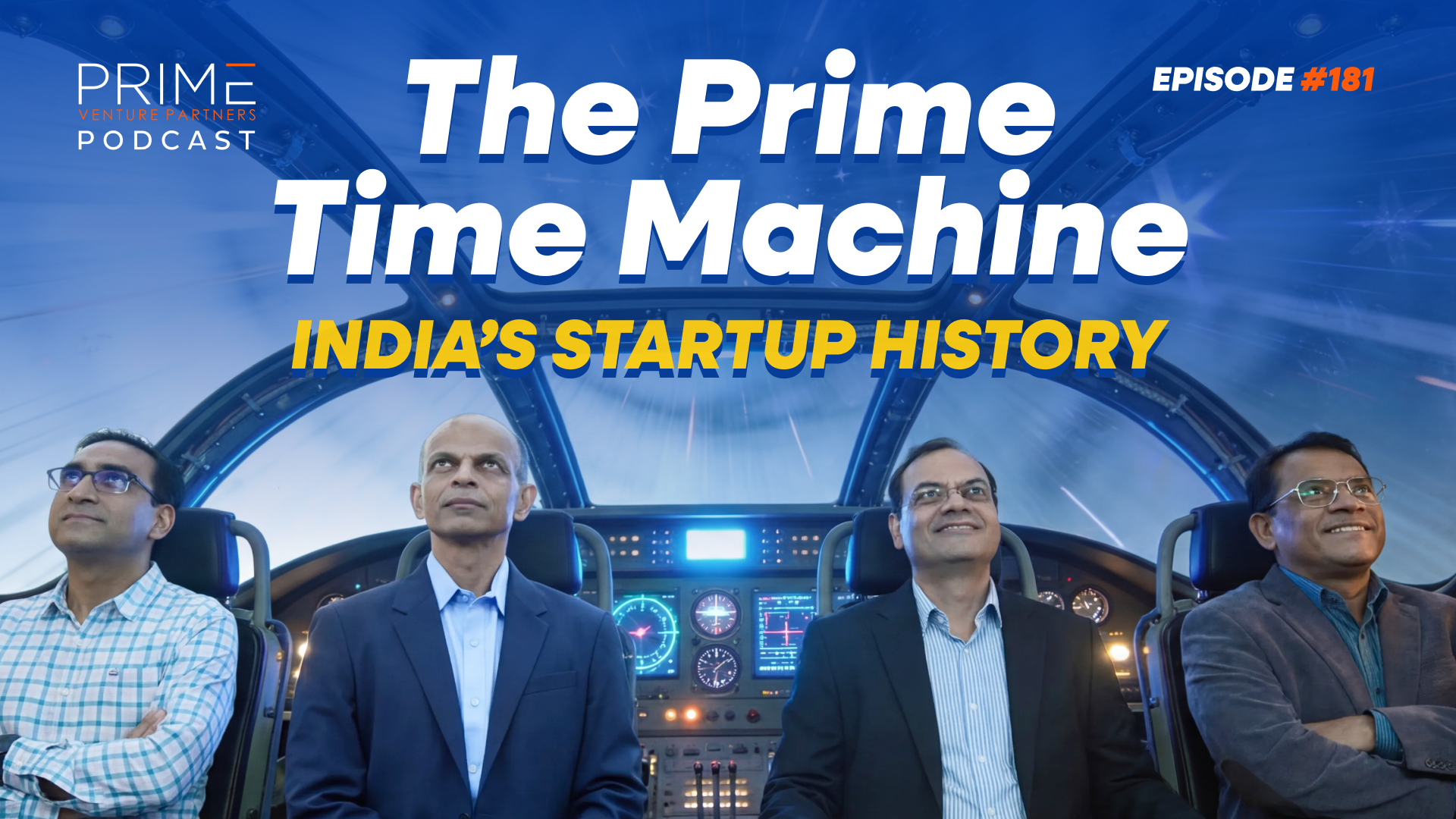
That memory becomes the premise of the episode: a rewind across 15 years of Indian venture capital, framed as a journey through three eras: 2010–2015, 2015–2022, and 2023 onwards. Bhushan calls it “The Prime Time Machine”. Not literal time travel, he clarifies, but something more valuable: lived memory.
The Wild West years (2010–2015)
Sanjay Swamy begins by going even further back.
“Building a startup seemed like a fun and cool thing to do. Nobody knew what this could lead to.” He recalls a time when projections were guesswork at best. “I once sent a revenue projection of zero, comma zero, comma zero.”
The first generation of Indian startups, he explains, was not built on deep conviction about outcomes. “We were building what we thought were products people would need, without fundamentally thinking through what it meant to build a business.”
Many companies shut down. Some pivoted. A few survived long enough to define the ecosystem: Flipkart, Zomato, MakeMyTrip.
Yet, while founders were experimenting, something quieter but more consequential was underway. “At the grassroots level, we were laying some extraordinary foundations” Aadhaar, India Stack, UPI.”
At the time, Swamy notes, few founders truly grasped what these rails would unlock.
Shripati Acharya describes the investor side of that era as almost unrecognisable today. “The concept of seed funds or incubation didn’t really exist.” When Prime itself started, even explaining the model was difficult. “Investors would ask, ‘What do you mean by incubation?’”
Term sheets reflected that immaturity. “You’d see clauses like: if you write a cheque above two lakhs, you need my signature.” There was little understanding of risk capital, and almost no concept of exits. “Nobody had any clue where exits would come from.”
Founders we underestimated
The episode turns personal when Bhushan asks each partner to recall a founder they underestimated.
Acharya recounts meeting the early team behind what would become Quizizz. “They were building a game for middle school math and users were coming from all over the world.” What surprised him most was not the product, but the founder’s insight. “They understood what teachers and students were looking for.” Prime wrote a $500k cheque, and that company has raised $60+ million today.”
Swamy shares the story of a hardware founder who reinvented himself at nearly 50. “We backed the person, not the product.” After abandoning B2B, the founder pivoted to consumerism, taught himself digital marketing at night, moved cities to cut costs, and built a profitable global brand. “There is no age limit to reinvent yourself.”
Amit Somani reflects on meeting Deepinder Goyal when Zomato was still FoodieBay. “I would never have imagined he’d build a $30-billion company.” The same disbelief applied to Ola. “Very young, very early, but completely unrecognisable 15 years later.”
Bhushan adds his own miss: Urban Company. “We passed because we were worried about operational complexity.” The lesson, he admits, is enduring. “At the end of the day, it’s founder grit and the drive to keep solving that matters.”
The rails that changed everything (2015–2022)
If the first era was experimentation, the second was infrastructure.
Acharya is candid. “The short answer is no—we did not imagine Aadhaar and UPI would have this impact.” Belief was fragile. “People said, why will anyone stand in line to give biometrics?”
Yet change became visible in small moments. “An entrepreneur told me, earlier we had to climb a hill to get data. Now I get it from my home.”
Swamy adds the scale behind the miracle. “Enrolling 1.3 billion people meant 25 people every second, for six years.” He calls it “a miracle” built for “50 rupees per enrolment.”
Somani connects the dots: Android phones, Jio, demonetisation, UPI. “EdTech went through the roof. Fintech went through the roof.”
Crisis as a catalyst
COVID tested everything.
“Revenue went to zero,” Somani recalls, citing MakeMyTrip. The response, he says, was “zero-based accounting, look at every cost from scratch.”
Swamy speaks about backing Dozee entirely over Zoom. “We never met the founders physically.” Demand exploded overnight. “Ten thousand devices deployed.” Then vanished just as quickly. “The company had to restart.”
Acharya reflects on humility. “We thought it would be a two-three month thing. We were completely wrong.”
The AI moment
When the conversation reaches AI, it avoids abstractions.
Somani describes PlanetSpark. “Thirty per cent of learning is now self-taught, enabled by AI with humans still in the loop.”
Acharya shares Zuper’s hands-free roofing assistant. “Just by talking, the roofer generates a full quote – area, materials, pricing.”
Swamy sees a deeper shift. “Companies that built internal AI tools are now realizing those tools themselves are products.” He draws the analogy plainly. “Like Amazon and AWS.”
Where the time machine lands
In closing, Bhushan asks for reflection in one line.
Somani returns to the metaphor. “We were on the ground floor of a tall building. Now we’re moving fast past the 20th floor and accelerating.”
Acharya chooses a different lens. “Ubiquitous digitisation and real financial inclusion has changed the canvas entirely.”
Swamy ends with restraint. “The plane stayed on the runway longer than we thought, but it’s now ascending to heights we never imagined.”
The time machine stops there. Not because the journey is complete but because, as Sanjay puts it, “the best is yet to come.”
Listen to the full podcast episode to gain more insights.
Timestamps:
00:00: Introduction
03:17: The three phases of the Indian startup ecosystem
05:16: Early founder reality (2010–2015)
08:09: What it was like to be an investor in early 2010
11:36: When no one even talked about exits
12:49: Early unicorns and the first belief shift
15:05: Founders we underestimated and why it changed our thinking
19:07“: Backing people over plans
23:29: India’s ‘too operational’ companies that scaled big
27:46: Jio and the moment the internet became affordable
29:33: When the internet truly reached Bharat
31:43: Aadhaar, India Stack, and building at population scale
35:16: COVID: Revenue to zero and zero-based accounting
39:00: Crisis decisions, calm leadership, and founder resilience
43:20: The crypto wave: Knowing what not to chase
46:34: Practical AI use cases inside real companies
54:07: Lessons from 15 years of venture investing
58:59: India’s startup ecosystem in one minute
Edited by Swetha Kannan
Discover more from News Link360
Subscribe to get the latest posts sent to your email.