
“Worry Is a Misuse of Your Imagination”: The Fix That Actually Works

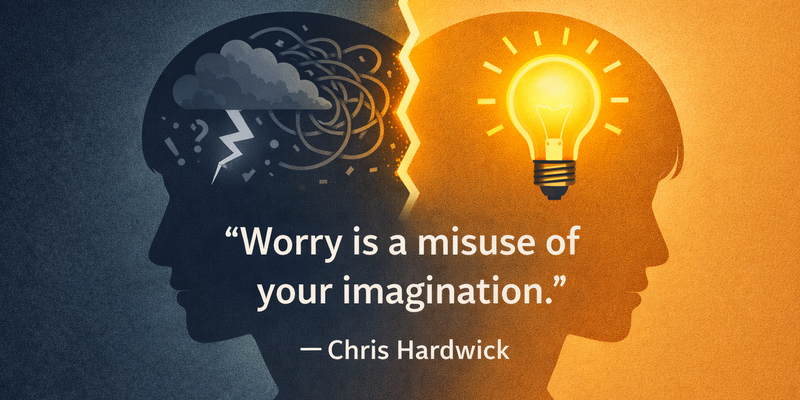

It’s a line that lands because it names something most people feel but rarely describe well: worry is not just fear. It is creativity pointed in the wrong direction.
Imagination is one of the most powerful human tools. It helps people build companies, raise families, write stories, solve problems, and plan for the future. But that same ability can also run endless “what if” scenarios usually negative ones until the mind feels crowded, tired, and stuck.
Hardwick’s quote is a reminder that worry often looks like preparation, but behaves like sabotage.
What worry really does to the mind
Worry is a mental rehearsal for failure. It creates vivid scenes of what could go wrong, then asks the body to react as if those scenes are already happening.
That’s why worry feels exhausting. It consumes attention, shortens patience, and makes even normal decisions feel heavier than they are. The mind is working hard—but not productively. You’re generating content, not outcomes.
In practical terms, worry often leads to:
- Overthinking instead of starting
- Delay disguised as “planning”
- Worst-case loops that feel urgent but change nothing
- Emotional spending—burning energy on events that haven’t occurred
If imagination is fuel, worry is a leak.
Why worry feels useful (even when it isn’t)
Most people don’t worry because they enjoy it. They worry because it offers a false promise: If I think about the danger enough, I can prevent it.
But repeated worry rarely improves decisions. It usually narrows them. It pushes the brain toward safety-first thinking, even when the situation requires clarity, creativity, or calm.
Worry can also become a habit of control. When life feels uncertain, the mind tries to regain certainty by running scenarios. The problem is that scenarios multiply faster than real solutions.
A healthier use of imagination
If worry is imagination misused, the fix is not “stop imagining.” The fix is redirecting the imagination toward what is actionable.
A useful imagination asks:
- What is the next step I can take today?
- What information do I actually need?
- What outcome do I want, and what is within my influence?
- If the worst happens, what would I do first?
Notice the shift: from spinning to structuring.
Worry says, “What if everything collapses?”
Productive imagination says, “If something goes wrong, here’s my plan. Now, back to what I can do.”
A simple way to separate “signal” from “noise”
One of the cleanest editorial rules for the mind is this: worry without action is noise.
To turn worry into signal, you can run it through three questions:
Is this problem real right now?
If not, schedule it. Yes—schedule it. Give it a time later, and return to the present task.
Can I influence it?
If yes, write down one action. If no, name it clearly and let it pass without negotiating.
What is the smallest useful step?
Small steps restore agency. Agency reduces worry faster than reassurance does.
This doesn’t eliminate anxiety overnight. But it does something more important: it stops worry from impersonating responsibility.
What this quote teaches about modern life
In an always-on world alerts, news cycles, comparisons, and constant performance pressure worry has become socially acceptable background noise. People even bond over it.
But imagination was never meant to be a permanent threat-detection system. It was meant to be a maker’s tool.
Hardwick’s quote is short, but it carries a bigger idea: your mind is a studio. You can either use it to design solutions or to produce disasters that never arrive.
Worry is not proof that you care. It’s proof that your imagination is active.
The question is: where is it pointed?
Use your imagination for planning, problem-solving, and possibility. When worry shows up, treat it like a misdirected draft—not a final version. Redirect it, edit it, and publish action instead.
Because the real goal is not to live without uncertainty. It’s to live without letting uncertainty run the newsroom in your head.
Discover more from News Link360
Subscribe to get the latest posts sent to your email.