

The Risks and Rewards of AI in School: What to Know
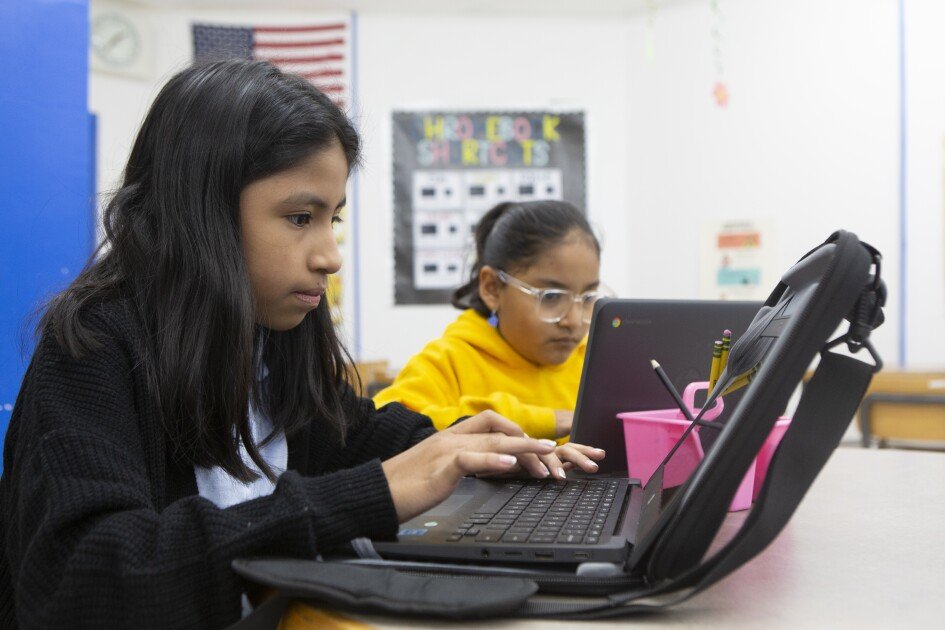
Yet the reality is that 85% of teachers and 86% of students across the country used AI at some level during the 2024-25 school year, according to a study by the Center for Democracy and Technology. And 69% of high school students said they use AI tools regularly to find information, and 54% use them to answer questions, according to College Board surveys.
Advocates of AI highlight its potential to personalize education and boost productivity, while skeptics are concerned that students may become overly reliant on the technology.
“The risks are undermining young people’s ability to think independently, take feedback, relate to each other, and have a trusting [teacher-student] relationship,” said Rebecca Winthrop, a director of the Center for Universal Education at the Brookings Institution and a lead researcher on the group’s report about AI.
In a conversation with Education Week, Winthrop discussed the report’s findings and the best ways to utilize benefits while minimizing risks when using AI in schools.
This interview has been edited for length and clarity.
What are the benefits of using AI for student learning?
What we found was that there are real benefits of generative AI for students learning when the power of AI is held back, used very narrowly, integrated with vetted content and good pedagogy.
So things like interactive textbooks or worksheets where kids are reading a paragraph over and over, don’t understand it, and are able to say [to AI]: “I don’t understand this, explain this to me in a different way.” That really helps kids learning.
It can be incredibly helpful for neurodivergent kids. One of the most striking examples is kids with aphasia who have communication problems. All of a sudden, they are able to create a synthetic copy of their voice and communicate in the classroom.
What risks does AI pose to student learning?
Because so many people have access to technology and broadband devices, young people encounter Gen AI everywhere. We call it wide AI use, which is basically unscaffolded, open-ended interactions with AI companions or chatbots. This seems to really undermine multiple things so for the normal, not super motivated students, they’re often using AI to shortcut their learning, often through homework. So it’s undermining cognitive development.
And the other piece is a lot of kids are using these AI companions often outside of school, and they’re very sycophantic in that they are designed to constantly make kids feel good and say how great they are, and we are quite concerned that young people start developing their emotional habits and muscles in a way that they can’t take feedback, which is at the core of the teaching and learning process.
The introduction of Gen AI in terms of the mass rollout seems to be undermining the trusting relationships between teachers and students. Teachers don’t really trust that their students are actually doing the work, [students] are also not trusting that their teachers are actually grading their work or developing their own assignments.
Are teachers tapping into the full potential of AI?
The real transformational benefit of AI is its strategic use in things like interactive virtual reality. When you’re studying biology, and kids can put on a headset, have some type of immersive experience where they can interact with their surroundings, ask questions, and see the inner workings of a plant’s photosynthesis, that has incredible potential.
A number of educators in our study said they are “saving a lot of admin time at the moment” using AI. It’s helping and it’s letting them do things more quickly, so it is augmenting what they’re able to do.
How do you think AI literacy is keeping up with its adoption in schools?
There’s a number of nonprofits and organizations developing AI literacy frameworks that are quite good. The one I often refer to because it is a collaborative effort across multiple education organizations is Teach AI, which is led by Code.org.
Kids need to understand that generative AI is not the laws of physics. A bunch of people have worked on this for a long time in rooms, largely in tech companies. Young people could probably come up with great ideas of how to design AI to serve their needs, in learning, and that sense of agency over how AI is designed is going to be really important for young people as they live in a world saturated by AI for the next decades.
Are schools adopting AI-powered tools too quickly?
It really depends on the school district. I talked to a superintendent in Connecticut recently who said, “My motto is go slow to go fast.” So, let’s figure out what is helpful about it and how we can mitigate the risk to harness it well. I talked to another superintendent in Pennsylvania [who is resisting the use of AI and said]: “We’re going back to all primary sources.”
So there are some folks who are taking a much more cautious approach.
Discover more from News Link360
Subscribe to get the latest posts sent to your email.