

Inside Deepflow Technologies’ mission to bring reliable farm intelligence to Indian farmers
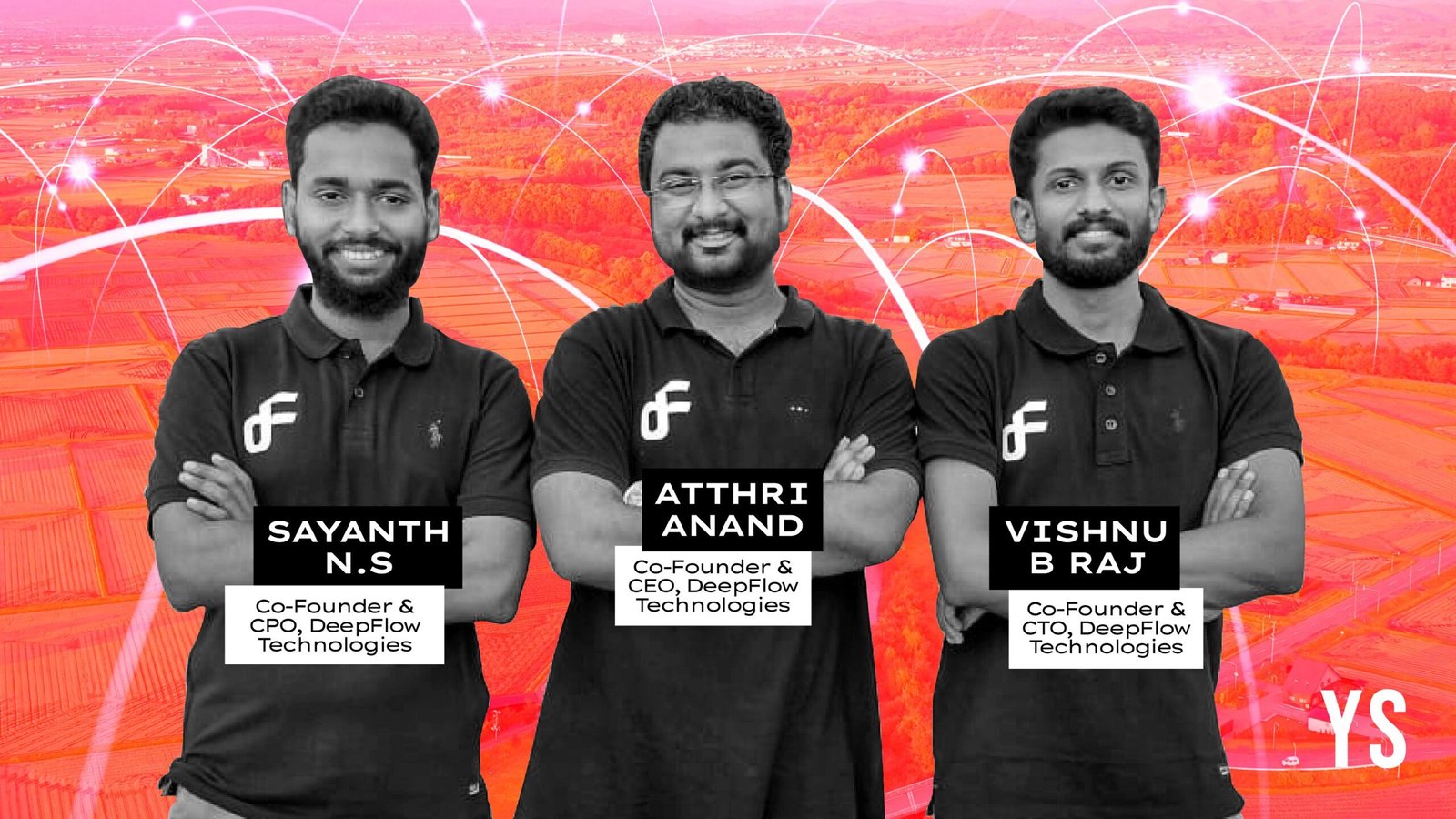

“As we explored the problem deeper by interacting with farmers and understanding on-ground realities, we realised that the challenge wasn’t just labour or mechanisation, it was the lack of timely, reliable, and hyperlocal decision-making support,” Anand tells YourStory.
Building on that insight, the trio co-founded agritech startup Deepflow Technologies later that year, which utilises AI and deeptech solutions to address critical issues faced by farmers in India.
“What started as a robotics idea gradually evolved into a broader mission: using data, intelligence, and automation to empower farmers and supporting stakeholders to make better decisions amid climate uncertainty,” he adds.
The Kannur-based startup employs nine people with Anand as CEO, Raj as CTO, and Sayanth as CPO—all residing in Kerala, close to farms, plantations, and field ecosystems. It is incubated at IIM Bangalore’s NSRCEL, which Anand says gives the startup access to mentorship, strategic guidance, and the broader startup ecosystem.
Developing an integrated agri-intelligence ecosystem
Deepflow’s products are designed as an integrated agri-intelligence ecosystem that combines on-ground data collection with digital decision support for farmers, farmer collectives, enterprises, and institutional stakeholders.
Its Augmented Weather Stations continuously capture parameters, including temperature, relative humidity, rainfall, atmospheric pressure, and wind speed. This real-time data is transmitted to the cloud and is combined with advanced weather models from IndraWeather, powered by mistEO, to generate hyperlocal forecasts and alerts.
Complementing this is Deepflow’s Portable Soil Assessment Device, which enables quick, on-site assessment of key soil parameters, such as pH, moisture, N-P-K values, electrical conductivity, and temperature, with geo-tagging across multiple plots.
“All this information flows into our Farmer’s Assist Mobile App, which acts as the primary interface for farmers. Through the app, farmers receive personalised advisories on crop planning, disease risk, irrigation scheduling, and input optimisation translated into simple, farmer-friendly insights rather than raw data,” explains Anand.
.thumbnailWrapper{
width:6.62rem !important;
}
.alsoReadTitleImage{
min-width: 81px !important;
min-height: 81px !important;
}
.alsoReadMainTitleText{
font-size: 14px !important;
line-height: 20px !important;
}
.alsoReadHeadText{
font-size: 24px !important;
line-height: 20px !important;
}
}

He adds that using the technology has helped farmers achieve a 120% increase in average yield improvement, a 20% average cost savings, and an 80% increase in income.
It has also developed a farmer-friendly Krishi Bhavan platform—an end-to-end farm planning and implementation software for government departments, farmer-producer organisations (FPOs), and extension agencies.
The platform—an AI recommendation engine built using custom deep learning models for agriculture and climate-linked decision-making—enables officials to plan crop programmes, allocate resources, monitor field-level execution, track advisories, and maintain transparent, data-backed communication with farmers.
He explains, “Our system combines domain-specific AI models with intelligent language layers to ensure recommendations are both scientifically accurate and farmer-friendly. Together, our products create a seamless loop, from data capture in the field to decision-making on the ground, assisting agriculture stakeholders in moving from reactive farming to proactive, climate-resilient management.”
Building trust on the ground
Anand believes farmers don’t trust unproven promises, rather than the commonly held belief that they are resistant to technology. Before launching its first solution, Deepflow’s team spent nearly two and a half years on the ground, interacting with farmers and supporting stakeholders to understand real pain points.
This phase, Anand notes, was less about technology and more about listening, observing, and learning how decisions are actually made on farms.
“To bridge our initial lack of formal agricultural experience, we collaborated with agri-scientists from Krishi Vigyan Kendra, Kannur, and the Pepper Research Station, Panniyur. Their hands-on expertise and strong network of progressive farmers helped us design practical solutions and conduct multiple short, field-level pilots,” he says.
Instead of approaching farmers individually, the startup partnered with NABARD to deploy and validate its solution with 1,200 farmers in Kannur district through FPOs.
“Working with farmers as collectives built confidence, encouraged peer learning, and reduced the perceived risk of adoption. Equally important, we ensured that farmer feedback directly shaped our products—from device design and communication methods to advisory formats and training models—making farmers co-creators rather than end users,” shares Anand.
.thumbnailWrapper{
width:6.62rem !important;
}
.alsoReadTitleImage{
min-width: 81px !important;
min-height: 81px !important;
}
.alsoReadMainTitleText{
font-size: 14px !important;
line-height: 20px !important;
}
.alsoReadHeadText{
font-size: 24px !important;
line-height: 20px !important;
}
}

Business model and traction
The startup charges Rs 180 per month for its app, which the founders say was a first-year validation strategy rather than a long-term scaling model.
“As we gained a better understanding of smallholder farmer economics, we expanded beyond a pure B2C approach to also adopt a B2G2C model. Under this model, government departments deploy our platform at scale and offer it to farmers free of cost as part of impact assessment and resource management initiatives. In parallel, our hardware products follow a direct unit sales model,” says the CEO.
Through B2G2C deployments, Deepflow now works with over 3,200 farmers. The startup is actively engaged with four government organisations and several enterprise and institutional clients, including plantations, farmer collectives, and agri-focused institutions.
It recently partnered with Kelachandra Coffee to build a data-driven, climate-resilient coffee cultivation ecosystem across coffee estates in the Western Ghats.
A sectoral perspective
From his on-ground experience in Kerala and Karnataka, Anand believes Indian agritech is at a critical inflection point.
“The opportunity is real, but adoption is often overestimated. Farmers don’t need more dashboards or generic advisories; they need reliable, localised, and actionable intelligence that fits into their existing decision-making workflows,” he says.
Competing with Bengaluru-based startups such as Fasal and Fyllo, Deepflow differentiates itself through a unified platform approach that enables farmers and farmer collectives to manage multiple crops simultaneously, instead of building solutions around a single crop.
“This matters in the Indian context, where mixed cropping and plantation systems are common. We deliver farm-wide intelligence rather than isolated advisories. Our strength lies in turning fragmented data into coordinated action,” he says, adding that the startup plans to be involved in automating labour-intensive operations in complex plantation segments like coffee, tea, and rubber soon.
Edited by Suman Singh
Discover more from News Link360
Subscribe to get the latest posts sent to your email.