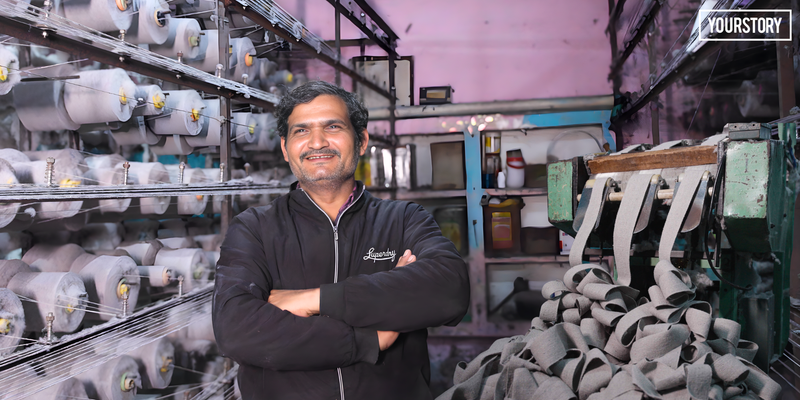
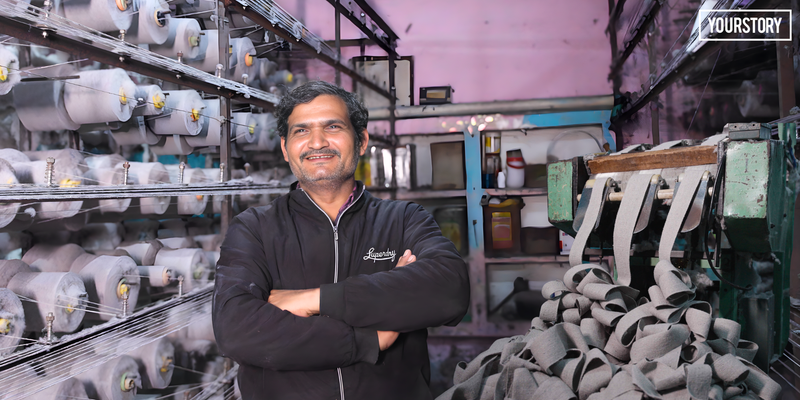

Over time, he also worked as a labourer in a textile-related setup where cotton strips were processed. That exposure stayed with him. When he heard from acquaintances about a government-backed scheme that could help him start his own venture, he decided to explore it further. He applied online and, after his application was approved, set up a small unit under the name Maa Chandrawal Textile in Mathura.
The business manufactures cotton strips, locally known as neval, which are primarily used for weaving charpoys and in tent work. The unit focuses only on these two segments. Production began about four to six months ago, and since then, operations have gradually stabilised.
Setting up with loan support
Ajayveer took a loan of Rs 5 lakh under the Mukhyamantri Yuva Udyami Vikas Abhiyan (CM YUVA) Yojana. Of this, about Rs 62,000 was contributed from his own savings, while approximately Rs 4.37 lakh was received as loan assistance. The funds were used to purchase machines, procure raw materials, and establish the basic setup required for manufacturing.
He says the absence of interest during the initial phase made the decision easier. “If you are afraid, you cannot work,” he says, reflecting on the hesitation he felt before starting out.
Earlier, he ran the machine himself for nearly a month. As orders began to come in, he hired a skilled worker to operate the machine while he focused on monitoring the rolling process to ensure the material quality remained consistent. His daughter assists in bundling the finished strips, and together with one hired artisan, the three manage the unit’s daily operations.
Gradual expansion beyond the district
The manufacturing process begins with preparing the raw material and running it through the machine to create cotton strips. Once produced, Ajayveer travels to identify buyers and secure orders. Initially, finding parties willing to place orders required repeated visits and negotiations, but over a few months, regular buyers began to emerge.
At present, most of the material is supplied to Agra. Recently, consignments have also been sent to Karnataka, where a few trial orders have been placed. Though still in the early stages, he says the response has been encouraging.
The CM YUVA Yojana, he notes, reduced the financial pressure during the initial months, allowing him to focus on establishing the workflow instead of servicing interest payments. For someone who previously received a daily wage, the shift to running a small unit has required learning about procurement, quality control, and market outreach.
Ajayveer says he does not plan to reduce operations and hopes to expand gradually as orders increase. For now, the income supports his household, and the work remains within his control. What began as labour in someone else’s unit has turned into a modest enterprise of his own, offering stability that daily wage work rarely provides.
Discover more from News Link360
Subscribe to get the latest posts sent to your email.