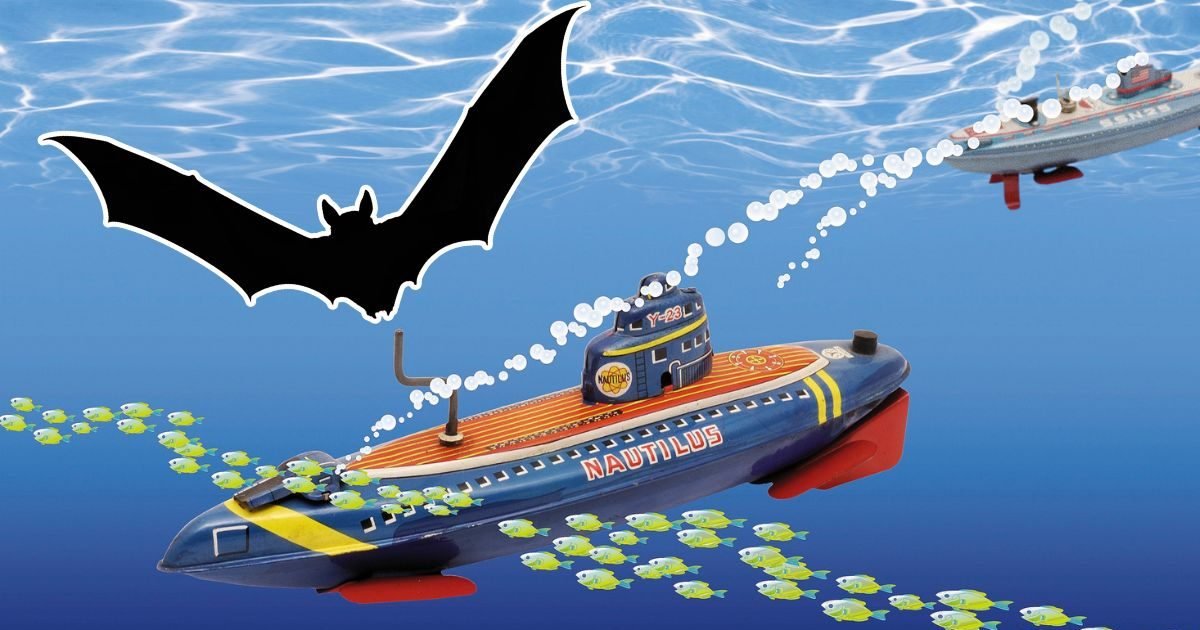
The bat of the sea is called a submarine.
A submarine is a warship of the sea, which does not move on the surface of the water, but hides in the depth. This is its biggest strength. It is neither easily visible nor can normal radar detect it. Submarines use sonar technology to locate enemy ships. This technique works on exactly the same principle as a bat finding its way in the dark.
Bats cannot see anything in the dark while flying. Still it does not hit any tree or wall. Have you wondered why this is? Actually, it releases sound waves. Or we can say that he throws his voice. The bat makes a sound something like “chik-chik”. That sound travels further, if there is a tree, wall, or anything else in front, then the sound collides with it and comes back to the bat. From the sound returned, the bat understands how far away the object is, in which direction and how big it is. This is the science of nature, which man has used for submarines.
The submarine sends sound waves into the water. When these sound waves collide with a ship and return, it gives an idea of the distance, direction and speed of the ship. This is why submarines are often called “bats of the sea” in maritime warfare.
Sneak and then precise attack
It is believed that at the time of the attack, the American submarine was moving about 100 to 300 meters below the sea surface. Above, the Iranian warship was moving at its normal speed.
The submarine hidden under water tracked the movement of the ship through sonar technology. Since the submarine remains completely silent, the ship sailing above is not even aware of its presence. For example, America’s Virginia class submarines make so little noise that their sound is sometimes less than that of a person swimming in water.
When the submarine reached the correct distance and position, it fired its most dangerous weapon, the Torpedo. It is a powerful underwater missile-like weapon, which moves straight towards its target.
What is a Torpedo? How does it work?
Torpedo is considered the most dangerous weapon of modern naval warfare. Usually it is 6 to 7 meters long and can move at a speed of about 60 to 70 kilometers per hour underwater. It is filled with 300 to 400 kilograms of explosives and its striking distance can be 20 to 50 kilometers. The special thing is that it is called “fire and forget” weapon. Meaning, fire it and then forget it.
Once the torpedo is released, it does not require any control. The small sonar installed inside it catches the sound of the engine of the enemy ship and keeps moving in the same direction. When it reaches near the ship, it makes a powerful explosion.
Torpedoes often explode just below the ship. There is a science behind this also. Because if the explosion happens on the side of the ship, it may just leave a big hole and sometimes the ship may be saved. But when the explosion occurs below the ship, the water pressure suddenly increases extremely high.
The huge bubble formed after the explosion first lifts the ship upwards and then suddenly pulls it downwards. This process is called “bubble jet effect”. Due to this shock, sometimes even heavy warships break apart and sink rapidly.
Discover more from News Link360
Subscribe to get the latest posts sent to your email.