
It happened to Sri Lanka’s Ajantha Mendis. Sunil Narine of the West Indies may also know a thing or two about it. Meanwhile, Indian fans can only hope the Varun Chakaravarthy code hasn’t been cracked. Not yet, at least.
For the first half of the T20 World Cup, batters prodded, poked, and misread. Varun was an unsolvable riddle of the group stage—the carrom ball had hurried past defences, and the googly had unsuspectingly crept up on many a batter like the late twist of an O. Henry classic.
But then the spell broke, and the game caught up.
Batters began committing to the drives and dabs earlier, forcing the World No. 1 T20I bowler to pull back his lengths and experiment with wider lines. And these small adjustments in T20 cricket can make or break an entire spell.
“The moment the batters start going after him, Varun switches to bowling medium pace,” Sunil Gavaskar noted during a game from the commentary box. He was right. There has been a drastic change in Varun’s pace of late. While a mere 2.7 per cent of his deliveries in the group stage clocked 100-plus kph, that figure has risen massively by 418 per cent in the last four games.
Something seems to have shifted since David Miller laid into him two fortnights ago. His figures have cut a sorry figure since: 1/47 against South Africa, 1/35 against Zimbabwe, 1/40 against the West Indies, and 1/64 against England.
The last game, especially, would have been soul-crushing. So much so that when that lone wicket of Jos Buttler came along, Varun folded his hands and sent a silent prayer up to the heavens while letting out a smile in relief. In that very over, Jacob Bethell had carved three consecutive sixes, welcoming Varun into the attack. It had prompted a worried Sanju Samson to ask the bowler to take more time between deliveries.
The sermons hardly worked.
By the end of the game, Varun had ended up bowling the joint second-most expensive spell (64 in four overs) in a T20 World Cup game, level with Sri Lanka’s Sanath Jayasuriya, who was sent on a leather hunt by Pakistan in Johannesburg 2007, in an unwanted records club.
“It is not that teams are attacking Varun or picking him. But if this (batters taking the attack to him) happens, you have to be tactical. You cannot miss the lengths. Line and length variations with speed variations are important. Varun has to be spoken to,” former India off-spinner Ravichandran Ashwin went on to say on his YouTube show.
“Every time he gets attacked upfront, the confidence goes down further. I am tired of saying this again and again. Do not bowl from around the wicket to the left-hander,” Ashwin added.
What he was perhaps trying to get at was that in the slam-bang format that is T20, bowlers must sometimes go back to adopting traditional defensive options to wreck the batter’s plans on a flat track.
Varun has reduced his over-the-wicket deliveries from 91.7 per cent to 70 per cent in the Super Eights.
If we slice his stats in the T20 World Cup neatly from the centre, there is a marked change in the back four when compared to the first four games, and in multiple aspects.
The number of deliveries channelled along the line of the off-stump has come down by 21.4 per cent, and he’s started pitching more on the line of the leg stump (1.3 per cent in the group stage to 13 per cent in the Super Eights). The good-length deliveries have also fallen to nine per cent from an earlier 27.3 per cent.
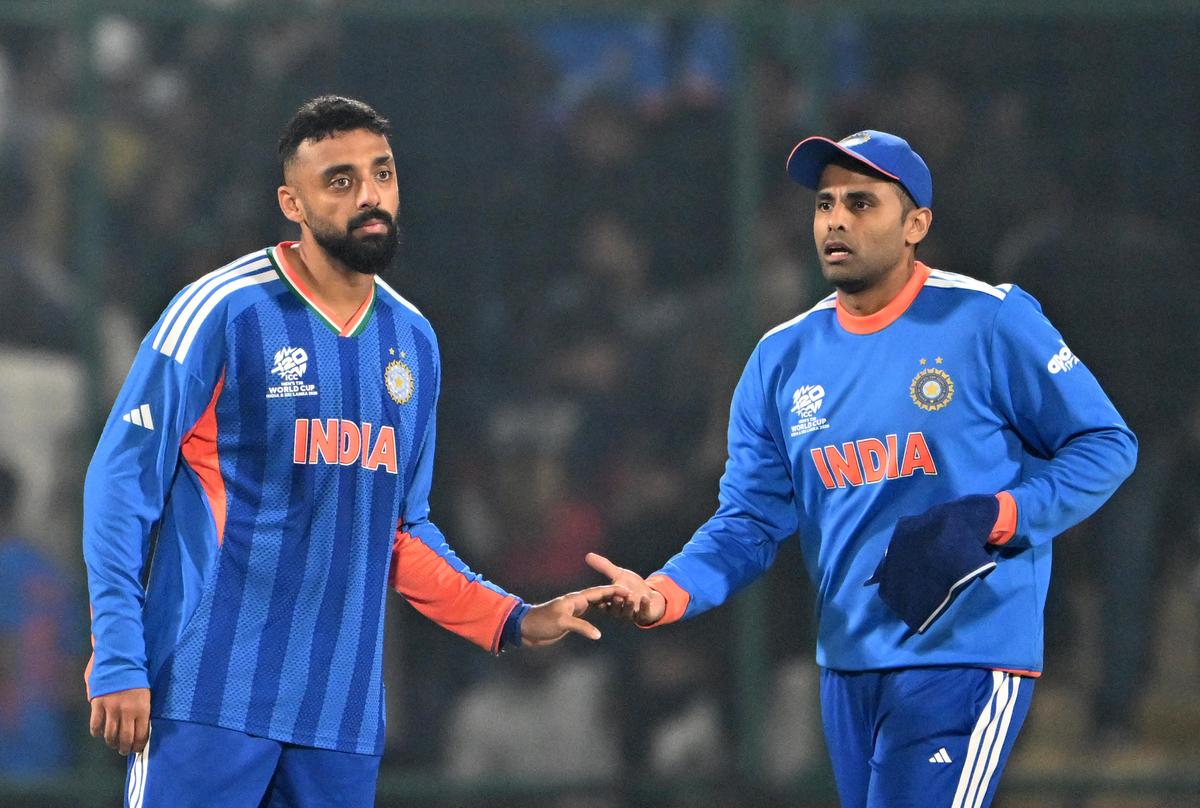
India captain Suryakumar Yadav (right) has hinted towards handing Varun a longer rope, saying, “There is nothing to worry about.”
| Photo Credit:
R. V. Moorthy

India captain Suryakumar Yadav (right) has hinted towards handing Varun a longer rope, saying, “There is nothing to worry about.”
| Photo Credit:
R. V. Moorthy
He’s gotten the ball to deviate away from the right-hand batter much more: 24 per cent, up from 9.5 per cent. While presently 23 per cent of his deliveries are projected to go on and hit the stumps, it used to be 30.1 per cent.
Coach Gautam Gambhir, however, isn’t one to be bothered by the statistical bombardment. “I don’t believe in data, honestly. I have never seen data. I don’t even know what data is all about,” he had said two games back.
Gambhir may not show it, but he will definitely be concerned by Varun’s waning returns.
The spinner who was going for less than six runs (5.16) an over until a few days back is now conceding 11.62 per six balls. He has taken only four wickets in the last four games, while averaging 46.50.
As the big final against New Zealand at the bigger Narendra Modi Stadium beckons, the calls for replacing Varun with the left-arm wristcraft of Kuldeep Yadav have started getting louder.
Kuldeep has played only one match in the 2026 T20 World Cup—against Pakistan, where he finished with 1/14.
In captain Suryakumar Yadav’s own words from the pre-match press conference: “Experience matters a lot going into such a lovely occasion. I think it will matter the most.” That is something Kuldeep provides aplenty, having played 174 white-ball games in India colours.
A high-risk-high-reward approach in the last over of the PowerPlay could potentially pit Kuldeep against the marauding opening duo of Tim Seifert and Finn Allen. Their opening stands are now worth 463 runs in the ongoing tournament; that includes one fifty-run and two century stands.
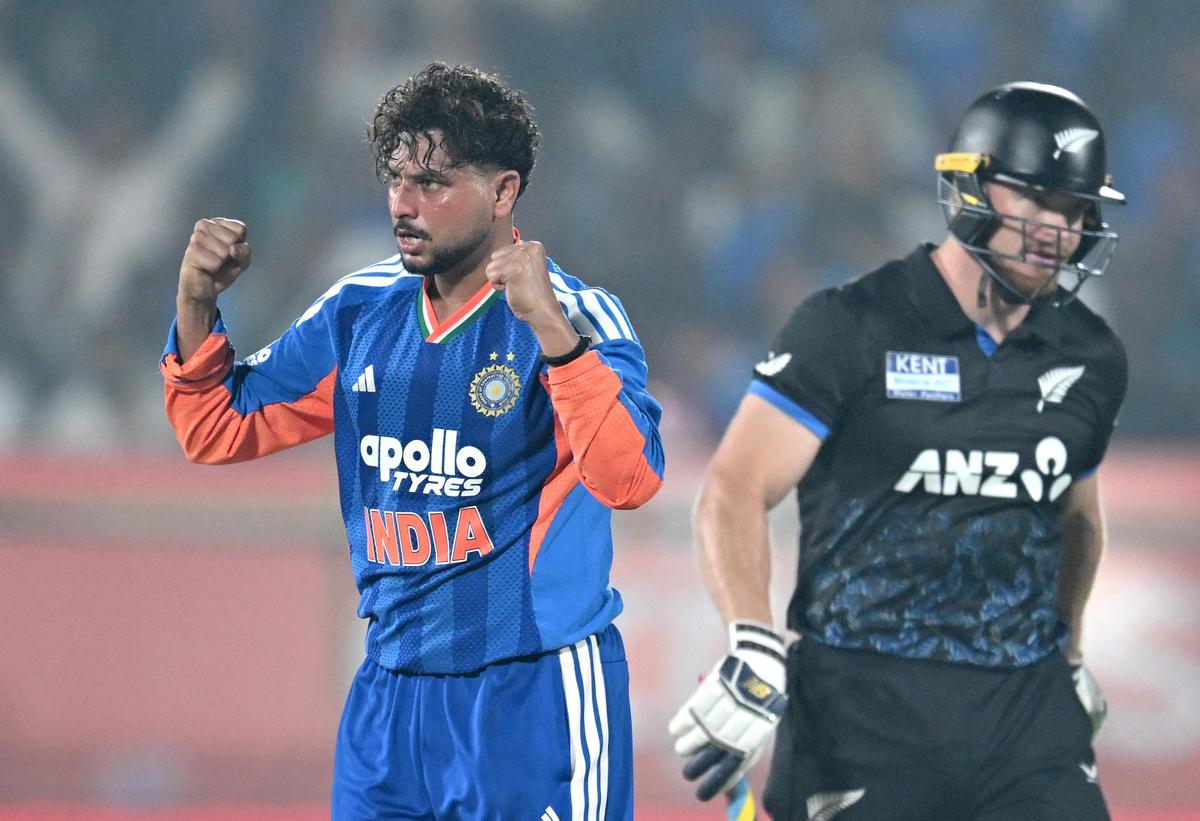
Kuldeep Yadav took four wickets in India’s previous T20 series against New Zealand and could be a potent alternative to Varun Chakaravarthy in the summit clash of the T20 World Cup 2026.
| Photo Credit:
K. R. Deepak
Kuldeep Yadav took four wickets in India’s previous T20 series against New Zealand and could be a potent alternative to Varun Chakaravarthy in the summit clash of the T20 World Cup 2026.
| Photo Credit:
K. R. Deepak
If Kuldeep can potentially move away from his stock delivery and land the googlies early, he can have a favourable matchup against Seifert if the right-hander is forced to play straight against the wrong’un.
Seifert’s penchant for the occasional sweep only strengthens Kuldeep’s case.
However, all said and done, India might not want to tinker too much with a winning combination, especially ahead of a summit clash.
Suryakumar too hinted towards handing Varun an even longer rope, saying, “There is nothing to worry about. We won the match (against England) eventually, and that happens when everyone is putting in collective effort. If we are winning games, we don’t worry about such things. Everyone goes through ups and downs. It is not possible for all 11 players to have a good day at the office. Varun is the world’s No. 1 bowler. He is well aware of how he can step up. He will definitely do that.”
It seems the answer to India’s biggest selection puzzle ahead of the final will arrive only when the coin lands.
Published on Mar 08, 2026
Discover more from News Link360
Subscribe to get the latest posts sent to your email.