
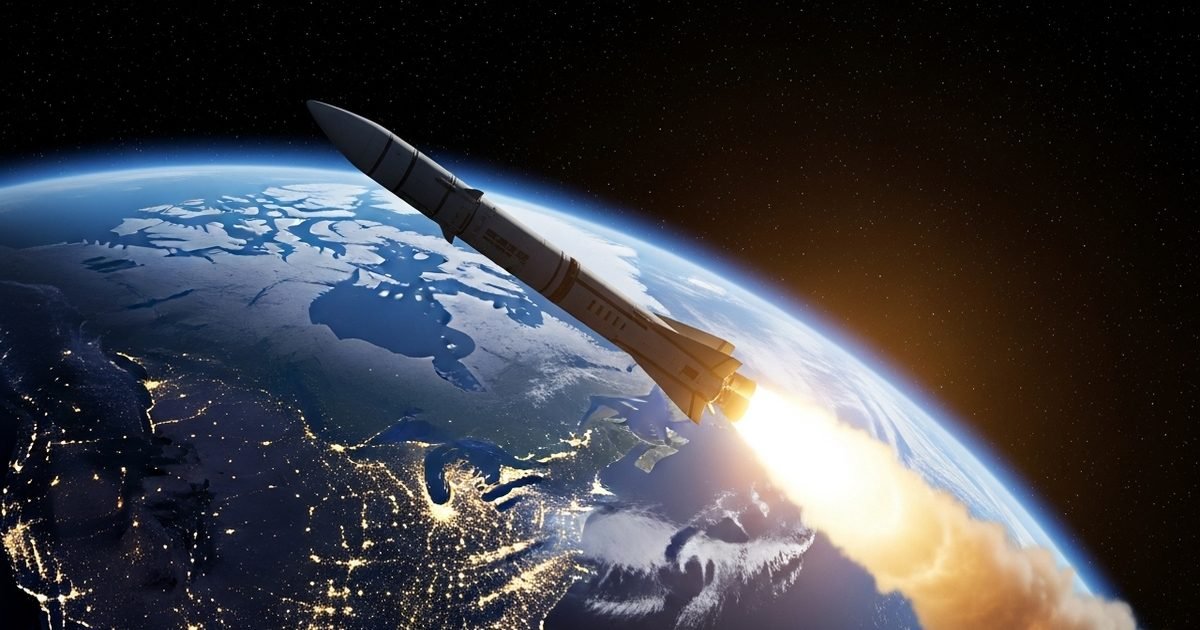
Iran has greatly improved its missile technology in the last few years, yet the impact of its missiles is currently limited only to its surrounding areas. Iran has missiles like ‘Shahab’ and ‘Ghadr’, which can reach a distance of about 2,000 to 2,500 kilometers. This means that Iran can target the entire Middle East, Israel and the US military bases there while sitting at home. These missiles are a big threat to the American soldiers in countries like Qatar, Kuwait and Saudi Arabia. But American soil is more than 10,000 kilometers away from there, so Iran’s current missiles cannot reach there.
Intercontinental ballistic missile can do this work
To attack a distant country like America, Iran would need a special type of missile, called Intercontinental Ballistic Missile (ICBM). This is not a common rocket, rather it has to go to space. To run it, it has to go through three major stages. Can Iran’s missile reach America? First a heavy rocket takes it high into the sky, then it floats on a fixed path in space, and finally it enters the Earth’s atmosphere again and falls on its target.
During this time its speed exceeds 20,000 kilometers per hour and due to friction the temperature reaches 7,000 degrees Celsius. Keeping the missile from burning in such heat and keeping it on target is one of the most difficult technologies in the world, which Iran has not yet achieved.
Which countries have such far reaching missiles?
If we compare with the rest of the countries in the world, only a few countries have missiles with such long range. Russia’s ‘Sarmat’ missile can go up to 18,000 kilometers, while America and China themselves also have missiles with a range of 13,000 to 15,000 kilometers. North Korea has also moved rapidly in this direction, but experts still have doubts over how accurate its missiles are. Iran is still far behind in this race. To reach America, it will have to increase the range of its missile by at least four times and acquire the technology to return from space to the ground.
America has no fear till 2035!
If we look at Iran’s future plans, some news is scary for America. In November 2025, Iran’s state media had claimed that they were making a missile that could go up to 10,000 kilometers. If this turns out to be true, the situation may change.
Experts and American intelligence agencies say something else. According to the Defense Intelligence Agency (DIA), “It may take at least till 2035 for Iran to prepare such a dangerous missile.” This means that for many years to come, there is very little possibility of Iran having any such missile which can fall directly on America.
America’s friendly countries are in danger
So does this mean that America has no fear of Iran? it’s not like that at all. Even if Iran cannot send missiles directly, it can harm America indirectly. Iran’s military and its supporting organizations (such as Hezbollah) can attack American interests in different parts of the world. As defense experts say, “The real threat is not from long-range missiles, but from proxy wars and small but deadly attacks.” The overall thing is that America’s soil is still safe, but its army and its friendly countries in the Middle East are always under the attack of Iran’s missiles.
Discover more from News Link360
Subscribe to get the latest posts sent to your email.