The ocean floor slowly stretches apart by allowing molten rock to rise up and form new crust. However, because this happens beneath the dark ocean waves which have not been witnessed by humans and actually seen it happen live—until now.
The recent study was published in the scientific journal Nature. An international team of scientists revealed that they have successfully captured a seafloor spreading event in real-time for the very first time in human history.
This geological event took place in the Indian Ocean, changing our understanding of how Earth constructs its outer shell.
What is Seafloor Spreading?
The outer crust of Earth is not a single and solid shell. Instead, it is broken up into massive, interlocking puzzle pieces called tectonic plates.
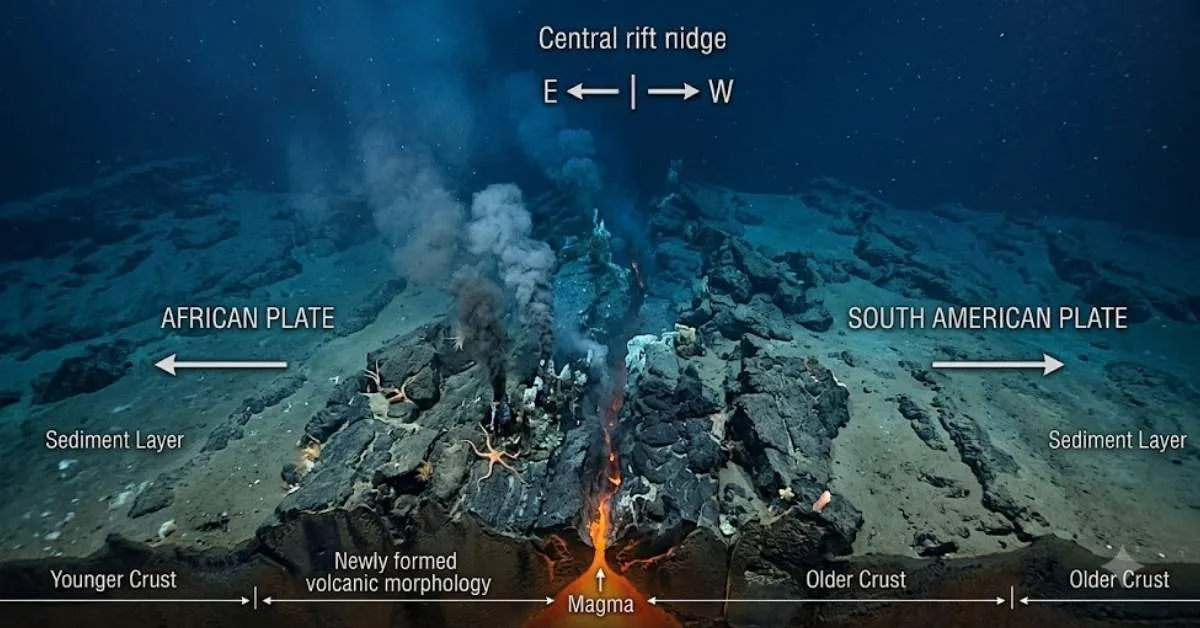
These plates are constantly moving places like at mid-ocean ridges. Mid-ocean ridges are large underwater mountain ranges. When these two tectonic plates slowly pull away from one another. This movement is called seafloor spreading.
As the plates separate, they create a fracture in the Earth’s crust. Molten rock called Magma rises from deep inside the Earth to fill the gap. When red-hot magma hits the near-freezing seawater, it cools rapidly, hardens into solid rock that becomes brand-new ocean floor.
-1783864341403.jpg)
Where and when did the event happen?
The event took place along the Southeast Indian Ridge. A massive underwater boundary in the southern Indian Ocean that separates two tectonic plates: the Antarctic plate and the Australian plate. These plates pull apart very slowly at a rate of about six centimetres per year. However, for this event, the real-time event began suddenly on 26 April 2024.
Two months earlier, scientists led by geophysicist Jean-Yves Royer had deployed an advanced underwater observatory network called the OHA-GEODAMS experiment. They placed more than 20 sophisticated sensors, microphones and pressure gauges across a 100-kilometre stretch of the ridge.
The scientists were hoping to measure the quiet, steady stretching of the crust over several years. Instead, they caught a massive, violent geological event.
Why is this discovery significant?
The event is called as geology’s ‘holy grail’ generally for two reasons.
A decade of movement in six days
The two to four metres of spreading that scientists witnessed in less than a week is equivalent to 30 to 60 years of normal Slow plate movement compressed into a single brief episode. This proves that the Earth’s crust grows in sudden, massive lurches rather than a slow, steady crawl.
Solving a long-standing mystery
Scientists had a problem when they added up all the movement caused by recorded underwater earthquakes for decades. The numbers never matched the actual speed at which tectonic plates move. This study solved the mystery.
The instruments proved that much of the ocean floor shifts quietly through aseismic slip which means the ground moves and faults slide without creating any detectable earthquakes at all.
Discover more from News Link360
Subscribe to get the latest posts sent to your email.