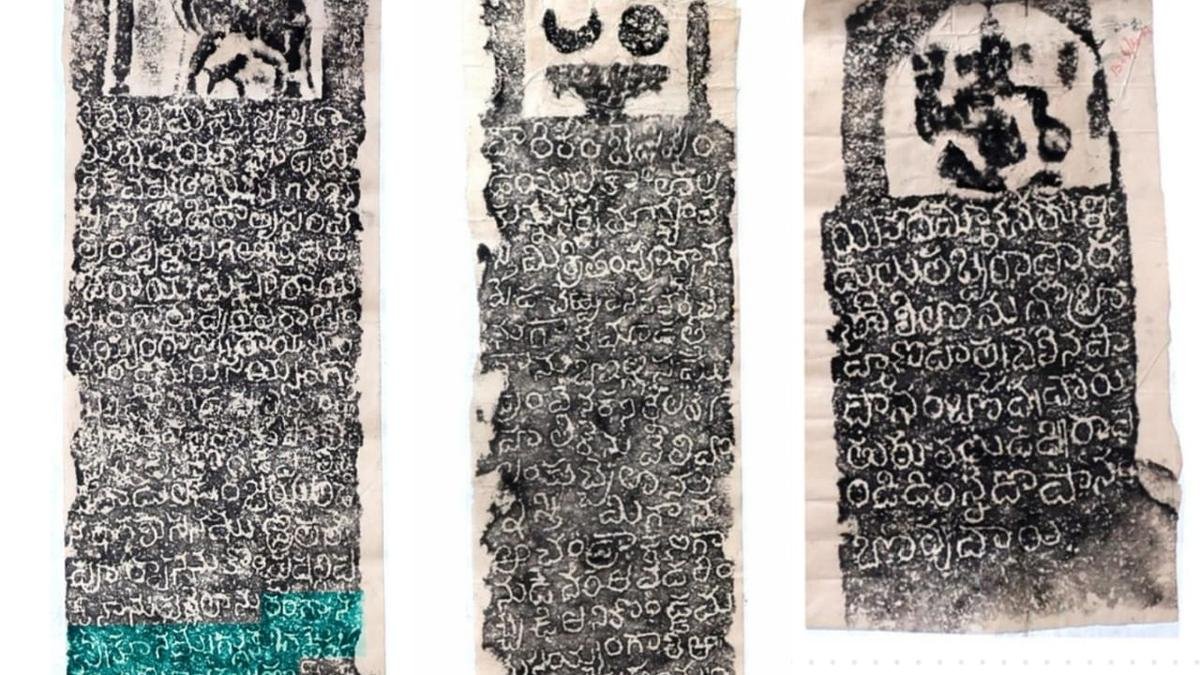
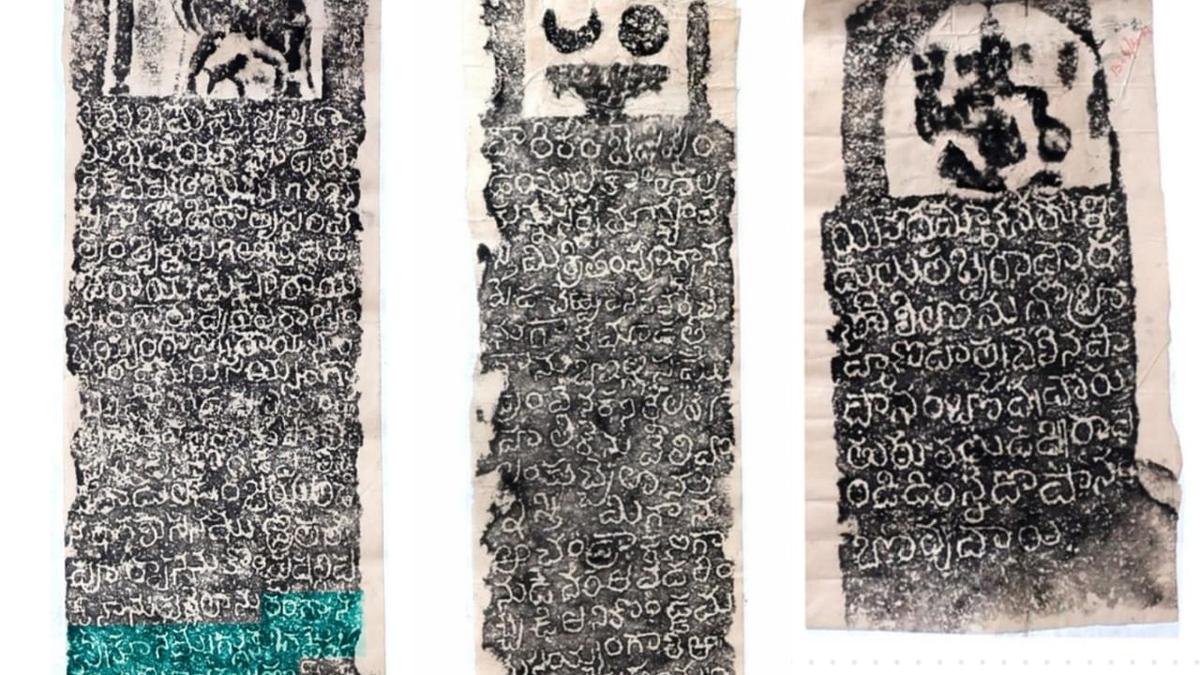
A Krishnadevaraya-era inscription from Gobbūr, now housed at the State Archaeology Museum, Hyderabad, providing the earliest epigraphical reference to the Bōnālu festival in Telangana.
| Photo Credit: By Arrangement
Significantly, the record states that these rituals and festivals were already in practice even before the period mentioned in the inscription, indicating that Bonalu has much older roots than previously documented. Scholars have also noted that practices such as Bonalu, Rangam, Kunamuggu and Pattnam (also known as Patnam), referred to in the inscription, continue to be part of Telangana’s living folk traditions to this day.
Munirathnam Reddy stated that the inscription, originally discovered at Gobbur, a border area between Telangana and Karnataka, is currently housed in the State Archaeology Museum, Hyderabad. Written in the Telugu language and script, it is dated Saka 1438 (Dhatu year), Jyestha śukla tritiya, corresponding to May 4, 1516 CE, a Sunday.
According to the inscription, certain levies payable to the government — including taxes on Rangam (oracle ritual), Kunamuggu, Gaddapattana and Bonolu — were exempt. It also records the grant of lands as sarvamanyam under the Pedacheruvu and Bollasamudram tanks, in addition to earlier endowments, for celebrating the Bonalu festival in the presence of the deity at Kondapalli. The grants were made on the orders of Rayasam Kondamarasayya.
The Director of Epigraphy, ASI, noted that the find adds an important historical dimension to the understanding of the festival, which is now widely associated with the worship of Goddess Mahakali.
Bonalu, an annual Hindu festival celebrated mainly in Hyderabad, Secunderabad and several other parts of Telangana, usually during Ashada Masam (July-August). Major celebrations are held at temples such as the Sri Simhavahini Mahankali Temple and the Akkanna Madanna Temple in Hyderabad, and the Sri Ujjaini Mahakali Temple in Secunderabad.
One of the central rituals of the festival is Rangam, a traditional oracle ceremony believed to facilitate direct communication between the goddess and devotees. During this ritual, a woman — known as Vishwamatta or Shakti — enters a trance and conveys predictions and messages. During the 2024 Bonalu festivities at the Sri Ujjaini Mahakali Temple, which began on July 22, the oracle ritual drew large crowds, with the possessed woman expressing the goddess’s satisfaction with the offerings, while also issuing cautions and appeals for the year ahead.
Published – December 23, 2025 07:57 pm IST
Discover more from News Link360
Subscribe to get the latest posts sent to your email.