

Meet the deeptech startup powering defence, disaster management, and critical intelligence
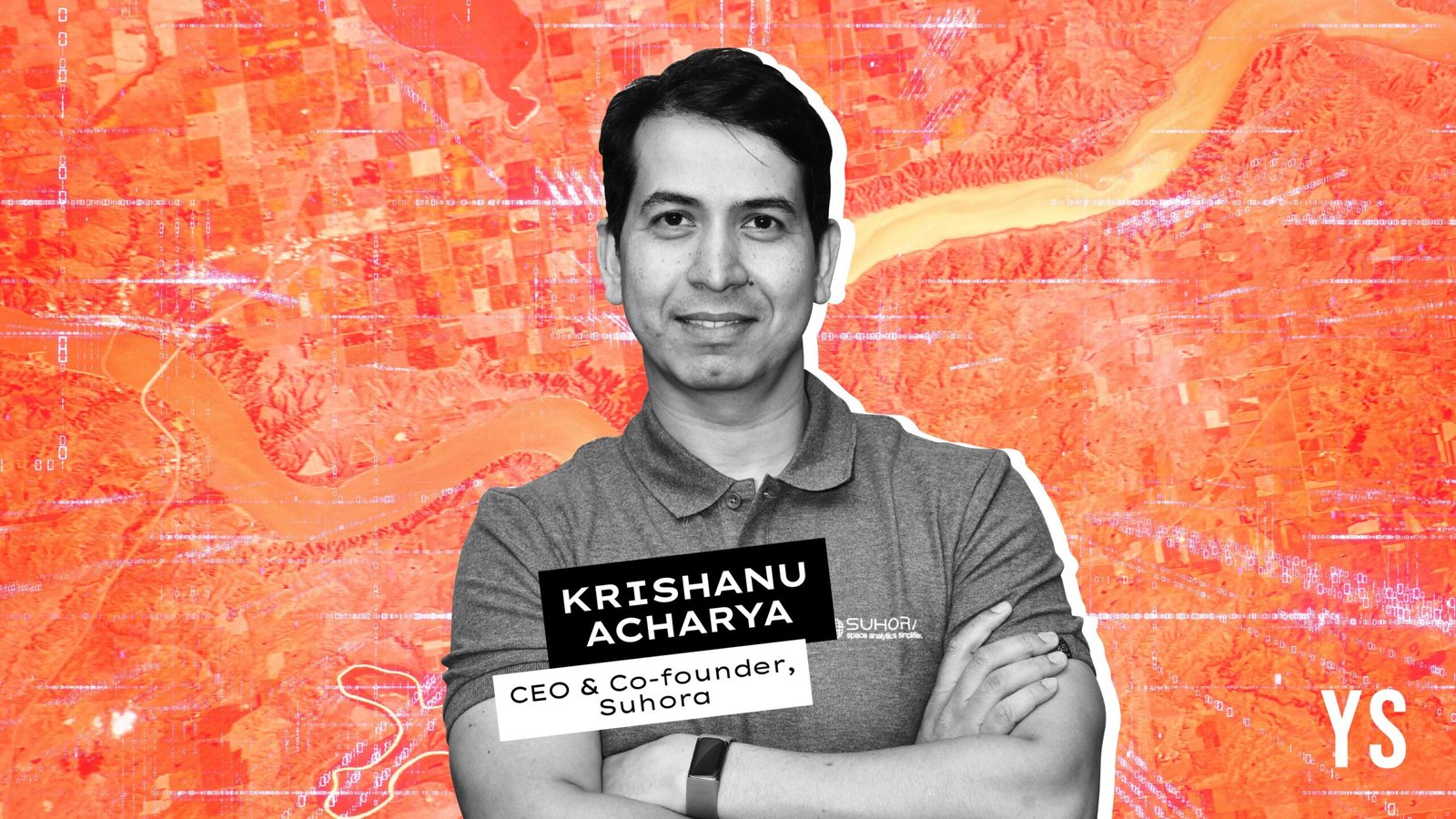
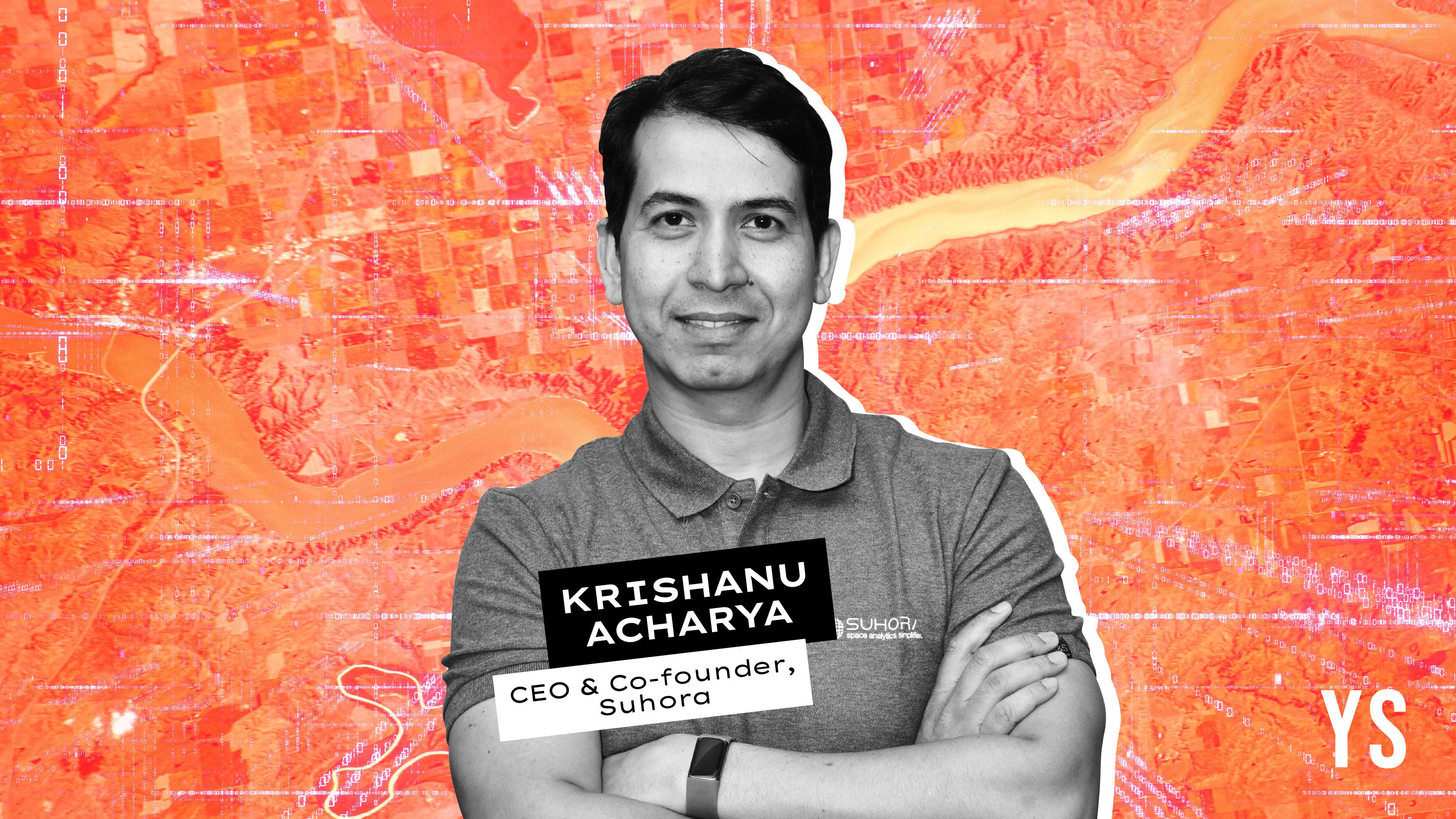

This is the gap Noida-based Suhora, a deeptech startup founded by Krishanu Acharya (CEO), is trying to fill. The startup builds geospatial intelligence systems that turn satellite images into real-time insights for defence agencies, disaster authorities, and energy companies, often within hours of an event.
“Our customers don’t want raw satellite data. They want intelligence. They want to know what it means. That is where we come in,” Acharya says.
Born in West Bengal near Kharagpur, Acharya completed his master’s in Remote Sensing and GIS from Vidyasagar University. He worked with a DRDO lab, followed by years at defence and geospatial companies, including Rolta and SkyMap Global, where he met future co-founders Rupesh Kumar (CTO) and Amit Kumar (COO).
“It’s a small industry. We all knew each other’s strengths. That helped us decide to build something together,” Acharya recalls.
The startup was registered in May 2018, but operations formally began in early 2019, after all three founders left their jobs. Suhora now operates from Noida, with a team of around 75 people. Its fourth co-founder, Admiral Vishwanathan Ganpati, an Indian Navy veteran, joined in November this year to lead system architecture and large-scale solution building.
From agriculture to defence: how the idea evolved
Early on, the startup saw the rise of smaller and cheaper satellites. “We saw miniaturisation happening around 2013–15. When satellites reduced in size, cost came down, access improved, and possibilities opened up,” Acharya says.
Suhora initially built a platform that could analyse satellite data for agriculture; its first field project was with the Maharashtra government. But the team soon realised where the real value lay.
“We understood that the premium and accuracy required in near real-time intelligence fit naturally with defence.”
Today, Suhora offers four products, all built on the same core technology. These products support a range of areas, including imaging, defence intelligence, disaster monitoring, and energy infrastructure.
.thumbnailWrapper{
width:6.62rem !important;
}
.alsoReadTitleImage{
min-width: 81px !important;
min-height: 81px !important;
}
.alsoReadMainTitleText{
font-size: 14px !important;
line-height: 20px !important;
}
.alsoReadHeadText{
font-size: 24px !important;
line-height: 20px !important;
}
}

What Suhora does
Suhora currently works with 300+ satellites, many of which it can task many directly through its own system. The company follows a B2B and B2G model, with revenue coming from a mix of SaaS offerings, intelligence delivery, and custom deployments.
“Users can buy data, but most want intelligence. We call ourselves an intelligence-as-a-service company,” Acharya tells YourStory.
Its earliest platform, Spade, is a SaaS-based satellite tasking system, which allows clients to task new images and view archive data. “You can task almost 300 satellites with a simple annual subscription,” Acharya says.
Prices start at $5,000 a year and scale to multimillion-dollar contracts for heavy users. Government departments such as Haryana’s HRSC use the system to monitor agriculture, stubble burning, and illegal construction.
For defence, the startup offers Mirka, a B2G-only platform used by the Indian Army, Navy, Air Force and intelligence agencies under the Ministry of Home Affairs, including CISF and BSF. Mirka combines computer vision, AI and a library of adversary assets to track changes on land and at sea, identify objects such as tanks or ships, and anticipate possible movements.
“It tasks satellites, pulls images in near real time, classifies objects, and predicts what can happen next,” Acharya says. The platform is priced at $25,000 a year.
Its disaster intelligence platform, SID, supports authorities during floods, landslides, and cyclones. After a recent flash flood in Uttarakhand, Suhora delivered a detailed assessment within two hours. “In disasters, the golden hour matters. Decision-makers need the right information fast,” Acharya says. State governments use SID as do B2B clients, including insurers and agriculture risk firms.
The fourth product, Joules, focuses on energy infrastructure and is already being used by renewable energy companies in the Middle East, including ACWA Power and Masdar. It grew out of Suhora’s earlier work on automated, detailed project reports (DPRs) and solar potential assessments. While the product has been deployed with clients, it is not yet listed on the website.
How the technology works
Suhora combines satellite tasking, computer vision, machine learning–based classification, and inference systems to turn raw images into actionable intelligence. “We are an AI-native company. Two things matter: automation and inference. We don’t just detect objects; we tell clients what the objects mean,” Acharya says.
The startup ingests hundreds of satellite images every day through global ground stations and AWS pipelines. All higher-level intelligence systems are built fully in-house.
Its government clients include the Indian National Coast Guard, Navy, and Air Force, several intelligence agencies under the MHA, and departments within the Haryana government. On the B2B side, the startup serves more than 10 clients, including Saudi-based ACWA Power, Masdar in the UAE, and Hyderabad-based Niruthi.
The bootstrapped company began with an initial investment of 15 lakhs from the founder’s own savings, achieving cash positivity from its first year of operations. It recorded around Rs 13 crore in revenue in FY24. Consistent growth led to Rs 40 crore revenue in FY25, according to the founder.
With its platforms now moving from pilot stages to larger deployments, Suhora expects strong year-on-year growth. Much of its revenue comes from large defence contracts and high-value satellite tasking, with some customers paying between $3 million and $4 million annually.
.thumbnailWrapper{
width:6.62rem !important;
}
.alsoReadTitleImage{
min-width: 81px !important;
min-height: 81px !important;
}
.alsoReadMainTitleText{
font-size: 14px !important;
line-height: 20px !important;
}
.alsoReadHeadText{
font-size: 24px !important;
line-height: 20px !important;
}
}

Competition and challenges
Suhora competes mostly with global deeptech companies. Acharya names US-based Venter and Israeli geospatial firms. In India, he mentions SATSURE as “a friend and sometimes collaborator”.
“There is no absolute competition. In this space, companies compete in some areas and collaborate in others,” the founder says.
Other challenges include hiring the right talent, navigating long procurement cycles, and maintaining confidentiality. “We guard our customers’ confidentiality with our lives,” Acharya says.
According to an Aetosky report, India’s geospatial analytics market is projected to grow to roughly $5-6.5 billion by 2030–2032. “We hold less than 2% of it, but aim to reach 15% in the next five years,” Acharya says.
What’s next?
Over the next 18 to 24 months, Suhora plans to push its products deeper into global markets. The team aims to officially roll out Joules worldwide and expand Mirka’s maritime intelligence capabilities across the APAC region. It is also working on adding edge-computation features for faster, last-mile intelligence delivery.
Suhora is also preparing to set up a ground station and exploring the possibility of launching its own satellites. “It’s in the deployment stage; we will launch soon,” Acharya says.
Discover more from News Link360
Subscribe to get the latest posts sent to your email.