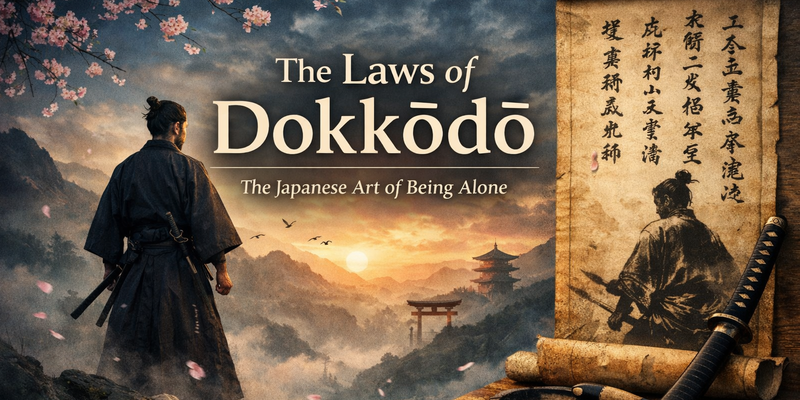

The principles of Dokkōdō were articulated by Miyamoto Musashi, one of Japan’s most renowned swordsmen and thinkers. Written in the final days of his life in 1645, the text outlines 21 precepts meant to guide a person toward inner independence, emotional restraint, and mental discipline. Though born in a feudal context, these laws speak powerfully to modern life.
What Dokkōdō Really Means
Dokkōdō is not about isolation or rejecting human relationships. It is about not being governed by them. At its core, the philosophy teaches self-reliance at the level of thought, desire, and identity. It asks a person to stand steady even when external validation, comfort, or certainty is removed.
Musashi lived much of his life as a wandering ronin, unattached to masters, wealth, or domestic life. His experiences shaped a worldview where strength came from simplicity and emotional economy. The laws of Dokkōdō reflect this outlook, urging individuals to strip away excess and face life directly.
Freedom From Attachment
One of the most striking themes across the laws is detachment. Musashi advises against clinging to pleasure, possessions, or even comfort. This is not asceticism for its own sake. It is a method of reducing dependency.
When happiness depends entirely on circumstances, it becomes fragile. Dokkōdō argues that by loosening our attachment to outcomes, approval, and material gain, we gain resilience. This idea resonates strongly today, when identity is often tied to status, productivity, or digital affirmation.
Emotional Discipline Over Emotional Suppression
Dokkōdō does not advocate emotional numbness. Instead, it promotes emotional control. Several laws caution against being ruled by desire, regret, or fear. Musashi believed that excessive emotional reaction clouds judgment, whether on the battlefield or in everyday decisions.
In modern terms, this aligns with emotional intelligence rather than repression. The goal is awareness without overreaction. To feel fully, but not to be dragged by feeling.
The Strength of Simplicity
Another recurring principle is simplicity in lifestyle and thought. Musashi discouraged indulgence in luxury, elaborate planning, or obsession with aesthetics. This was not a rejection of beauty, but a warning against distraction.
Simplicity creates focus. By reducing unnecessary complexity, a person conserves mental energy for what truly matters. In a world overloaded with choice and information, this principle feels especially relevant.
Walking Alone Without Being Lost
Perhaps the most misunderstood aspect of Dokkōdō is its emphasis on walking alone. This does not mean rejecting society. It means developing a core self that remains intact regardless of social presence.
To “walk alone” is to make decisions based on principle rather than pressure. It is the ability to stand apart when required, without bitterness or superiority. Musashi believed that true independence allows one to engage with the world more honestly, not less.
Practical Lessons for Modern Life
Applied today, the laws of Dokkōdō offer a counterbalance to anxiety-driven living. They suggest that peace comes not from controlling the world, but from controlling one’s responses to it.
For professionals, this may mean detaching self-worth from titles or metrics. For creatives, it may mean working without constant external validation. For individuals, it may simply mean becoming comfortable with silence, uncertainty, and one’s own thoughts.
Dokkōdō does not promise comfort. It promises clarity.
A Philosophy, Not a Rulebook
It is important to note that Musashi did not present these laws as moral commandments. They are observations forged through experience. They invite reflection, not blind adherence.
Taken together, the laws of Dokkōdō form a philosophy of inner sovereignty. They challenge the idea that fulfillment must come from accumulation, recognition, or constant connection. Instead, they point toward a quieter strength, one built through self-knowledge and restraint.
In learning how to be alone without fear, Dokkōdō teaches something more profound. It teaches how to be whole.
Discover more from News Link360
Subscribe to get the latest posts sent to your email.