



Biggest Companies That Were Born From Mistakes and Accidents
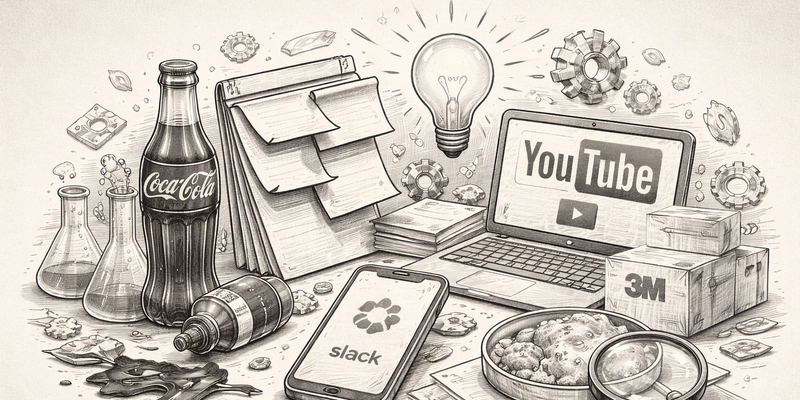
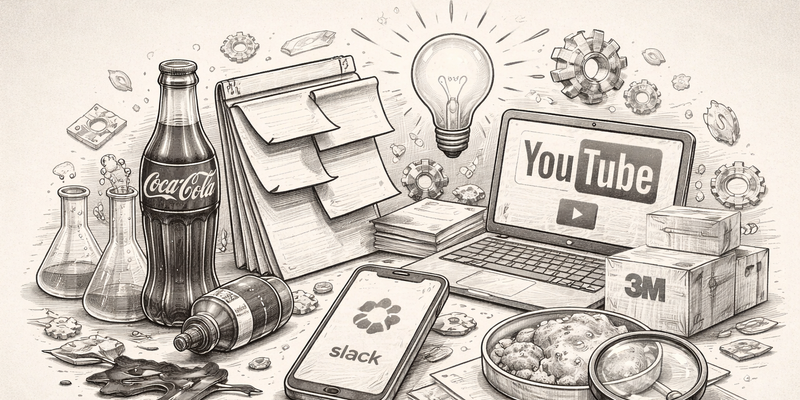

Here are some of the biggest companies and products that began as accidents, yet went on to reshape industries.
3M: A Failed Glue That Changed Office Work Forever
The multinational conglomerate 3M was built on experimentation, but one of its most famous successes began as a failure.
In 1968, a 3M scientist was trying to develop a super-strong adhesive. Instead, he created a weak glue that stuck lightly and peeled off easily. For years, it was considered useless. The breakthrough came when another employee realised this “failed” adhesive could be used to create reusable bookmarks.
That idea evolved into Post-it Notes, now one of the most recognisable office products in the world. What began as a rejected experiment became a multi-billion-dollar product line and a symbol of everyday productivity.
YouTube: A Dating Site That Nobody Wanted
When YouTube launched in 2005, it was not meant to be a video-sharing giant. Its founders initially designed it as a video-based dating platform, hoping users would upload clips introducing themselves.
The idea failed. People showed no interest in dating videos. However, users began uploading random clips instead—pets, events, jokes, and personal moments. The founders noticed this unexpected behaviour and pivoted quickly.
That accidental shift turned YouTube into the world’s largest video platform. Just over a year later, it was acquired by Google, cementing its place in internet history.
Slack: A Game That Never Took Off
Today, Slack is a core workplace tool used by millions. But it started as an internal communication system built for a failed online game.
The company behind Slack was developing a multiplayer game that struggled to gain traction. While the game faltered, the team realised their internal chat tool was solving real communication problems more effectively than the product they were selling.
They abandoned the game, refined the tool, and launched Slack as a standalone product. What was once a side utility became a dominant force in workplace collaboration.
Coca-Cola: Medicine That Turned Into a Global Drink
One of the most recognisable brands in the world, Coca-Cola, began as a medicinal experiment.
In 1886, pharmacist John Stith Pemberton created a syrup intended to treat headaches and fatigue. When mixed accidentally with carbonated water instead of plain water, the drink tasted better than expected. It was sold at soda fountains as a refreshing beverage rather than medicine.
The accidental combination transformed Coca-Cola into a cultural and commercial phenomenon, eventually becoming one of the most valuable brands in history.
Penicillin and the Birth of Modern Medicine
Not all “companies” born by accident began as businesses. Some discoveries later became entire industries. In 1928, Alexander Fleming noticed that mould had contaminated one of his laboratory samples and killed the surrounding bacteria.
Instead of discarding the sample, he studied it. That observation led to the discovery of penicillin, which later became the foundation of the modern antibiotic industry. Pharmaceutical giants and life-saving treatments followed, all rooted in a laboratory accident.
Why Accidental Success Matters
These stories share a common thread: attention, curiosity, and flexibility. The mistake itself did not create success. The ability to recognise unexpected value did.
In many cases, the original idea failed completely. What mattered was the willingness to pause, observe user behaviour, or rethink assumptions. Companies that succeeded were not those that avoided mistakes, but those that learned from them faster than others.
Failure as a Starting Point
In hindsight, these accidents look inevitable. At the time, they were uncertain, risky, and often ignored. Yet they remind us that innovation rarely follows a clean blueprint.
Some of the biggest companies in the world exist today not because everything went right, but because someone paid attention when something went wrong.
Discover more from News Link360
Subscribe to get the latest posts sent to your email.