



How EON Space Labs is advancing India’s spacetech sovereignty push with in-house imaging payloads

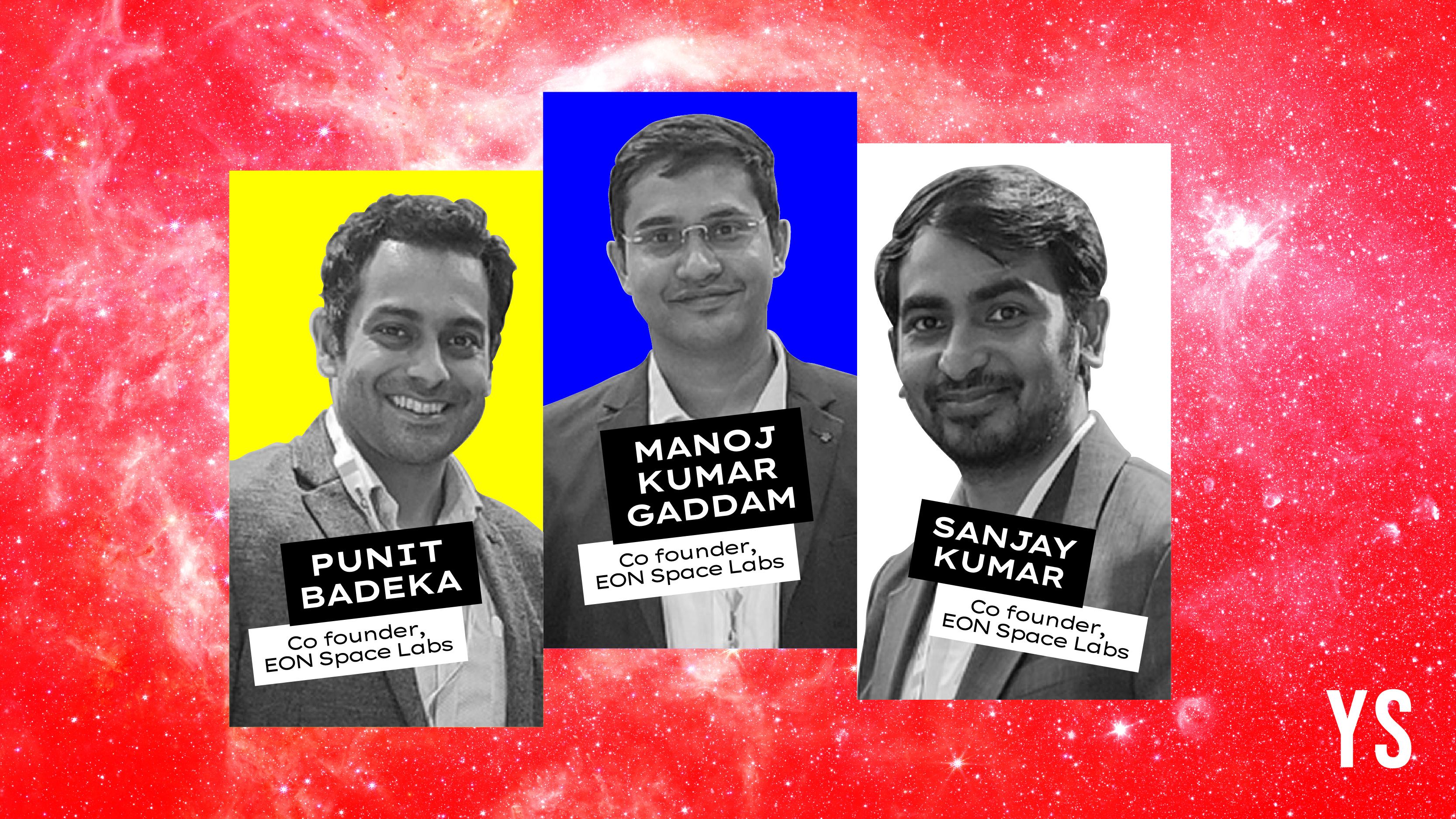

So, when private participation in India’s space and defence sectors accelerated in the late 2020s, the trio identified a glaring capability gap: India largely imported high-end Electro-Optical (EO) and Infrared (IR) imaging payloads.
“Timelines, costs, and strategic dependencies were outside India’s control. As of 2023, India only operated 24 active EO satellites, depending on foreign providers for nearly 80% of its high-resolution imaging data,” says Kumar.
They founded EON Space Labs in December 2022 to build and qualify indigenous world-class imaging payloads for dual-use needs, spanning CubeSats, satellites, drones, UAVs, and ground-mounted optics.
“High-resolution imaging is one of the hardest proving grounds for compact and miniaturised optics, and if a startup can produce a commercially viable space-grade imager indigenously, it can scale and use it for dual-use defence and commercial applications targeting the export markets,” Kumar tells YourStory.
Engineering for orbit, and beyond
EON currently employs 17 people, extending capacity through strategic partners and accredited infrastructure. Bengaluru-based HHV Advanced Technologies handles the startup’s optics manufacturing, while an NABL-accredited facility in Ahmedabad conducts flight hardware assembly and testing.
Its Hyderabad office setup also includes an EO and IR payload integration room and an AI-powered data processing and vision development lab.
EON’s flagship product is MIRA—an electro-optical payload engineered specifically for orbit. The co-founder says that MIRA is unique in its optics architecture. Instead of a conventional multi-element lens assembly, MIRA uses a monolithic lens machined from a single piece of fused silica.
Its lenses, miniaturised optics, and optical assembly are designed in-house and manufactured at HHV, helping EON get access to precision engineering.
“This method removes the risk of internal misalignment under launch vibration and high gravitational forces, while keeping a compact design suitable for 3U and larger CubeSats. This is a novel example of such miniaturised precision engineering developed by an Indian deeptech startup. Usually, CubeSat makers rely on imported off-the-shelf components,” Kumar explains.
.thumbnailWrapper{
width:6.62rem !important;
}
.alsoReadTitleImage{
min-width: 81px !important;
min-height: 81px !important;
}
.alsoReadMainTitleText{
font-size: 14px !important;
line-height: 20px !important;
}
.alsoReadHeadText{
font-size: 24px !important;
line-height: 20px !important;
}
}

Staying level-headed after a failed mission
According to Kumar, India’s dependence on imported imaging technology has become an expensive bottleneck for the sector. EON is focused on state-of-the-art imagers because the market now demands faster tasking, lower cost per insight, and domestic control over critical hardware.
In a collaborative effort, EON partnered with the Hyderabad-based CubeSat manufacturing startup TakeMe2Space to build a space-grade imager for Earth Observation.
Named MOI-1—the 6U CubeSat, developed by TakeMe2Space—integrates EON’s MIRA payload with on-orbit computing so that users can task the satellite and process imaging data directly in Low Earth Orbit (LEO).
Unfortunately, the flight was part of ISRO’s PSLV-C62 mission, which failed after it encountered an “anomaly” during the end of the PS3 stage earlier this week.
“We are grateful to ISRO for the opportunity to be part of the PSLV-C62 mission. As with all space missions, inherent risks are part of the journey, and such outcomes contribute to building a mature and resilient space ecosystem. We remain optimistic, focused, and committed to delivering a reliable, flight-proven payload,” says Kumar.
The founder adds that the spacetech startup’s next plan of action is to prioritise its second satellite, developed by TakeMe2Space, MOI-2, as the next flight opportunity and keep the MIRA payload flight-ready by the end of February, targeting a mid-2026 launch window.
The clientele climate
Kumar believes that Indian spacetech has evolved from prototyping to becoming a commercially viable industry, and the winners will be those who build export-ready sovereign capabilities.
Citing KPMG projections, he notes the global space economy could grow from $596 billion in 2024 to over $1.8 trillion by 2035. “India could capitalise on this growth from about a 2% share to 8% within the next decade,” he says.
EON is already seeing traction beyond space. It expects near-term revenue mainly from hardware sales, with products such as its LUMIRA EO and IR gimbals, fixed surveillance systems, and customised optics, with confirmed recurring orders over the next 24 to 36 months.
“A notable partner is [Bengaluru-based] Kepler Aerospace, which earlier this year signed a prime contract under the Defence Ministry’s iDEX initiative. EON will supply a MIRA variant for Kepler’s six-satellite ISR swarm constellation for the Defence Space Agency and Headquarters Integrated Defence Staff,” he says.
Further, EON has installed its Buho 225 ground imaging system at Vizag Port for the Indian Navy, helping with a maritime surveillance project to monitor ship movements. The system can detect and track ships at a distance of 10 kms, and its software—trained with AI and machine learning—is capable of detecting humans, vehicles, and drones.
.thumbnailWrapper{
width:6.62rem !important;
}
.alsoReadTitleImage{
min-width: 81px !important;
min-height: 81px !important;
}
.alsoReadMainTitleText{
font-size: 14px !important;
line-height: 20px !important;
}
.alsoReadHeadText{
font-size: 24px !important;
line-height: 20px !important;
}
}
Funding and the road ahead
In 2025, the B2B and B2G startup had raised about $1.2 million in a pre-Series A round led by MountTech Growth Fund-Kavachh, with HHV Advanced Technologies joining as a strategic investor.
Kumar says the funding will help scale multi-domain electro-optical hardware and computing across space, aerial, and ground platforms.
Sarjeet Yadav, Venture Partner, MountTech Kavachh, says the firm’s decision to fund EON Space Labs was due to the complementary technical expertise of the founders.
“We could envision them becoming a key player serving rising domestic demand for dual-use defence and commercial needs, while simultaneously capitalising on growing global export opportunities. EON aligns well with our vision of investing in deeptech startups that initially require patient capital but support India’s push for technological self-reliance,” shares Yadav.
Competing with global players like Next Vision and Teledyne FLIR, EON differentiates itself through a multi-domain focus, vertically integrated approach (control over the full chain) and an optical and AI stack scaled across space, aerial, and ground platforms.
“We currently use more than 90% indigenous content across optics, electronics, mechanics, and software, while calling out thermal image sensors as a key remaining import gap,” Kumar concludes.
(The copy was updated to reflect a change in the company’s description.)
Edited by Suman Singh
Discover more from News Link360
Subscribe to get the latest posts sent to your email.