


Maruti Suzuki expects capacity ramp-up, SUV push to support growth outperformance

On the broader industry outlook, Maruti Suzuki expects passenger vehicle volumes to grow at a steady pace over the medium term, even as current demand levels normalise.
The company is optimistic about outperforming industry growth, supported by a strong product pipeline, improving traction in exports, and the gradual rebound in small car demand.
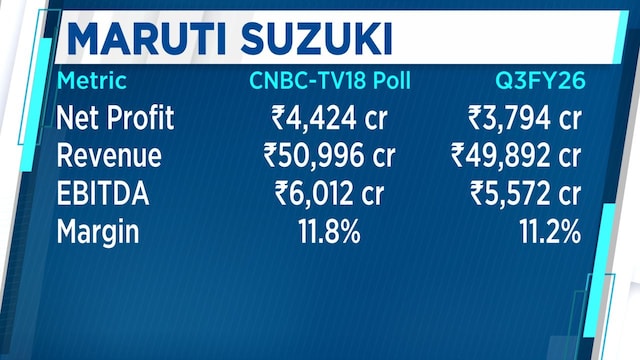
 In the October–December quarter (Q3FY26), Maruti Suzuki reported revenue of ₹49,892 crore, a net profit of ₹3,794 crore, and margins of 11.2%.
Below are the edited excerpts of the interview.
Q: How are margins shaping up once you adjust for the one-time Labour Code provision, and what are the key drivers supporting profitability right now?
A: If we remove the one-time provision of the Labour Code of about 125 basis points in quarter two we had a margin of 8.4%, in quarter three we had a margin of 8.1% EBIT – that’s a decline of about 30 basis points. But if we adjust the one-time, Labour Code provision, it’s an increase of almost about 100 basis points.
At the moment we have we do not see much commodity pressure, there are some early signals, and it may happen in quarter one next year; quarter four is broadly fine. There are some minor issues on commodities like precious metal, platinum, palladium, rhodium, but the overriding positive factor is volumes. If volumes go up, if the market is strong, then, of course, the operating leverage and the lower sales promotion, the price realisation, they all are able to offset that.
Q: You said there could be some pressure in the first quarter on margins. Fourth quarter, are they likely to be where it would be in, say, between the 8.50 to 9% sort of a mark?
A: Fourth quarter is mostly where quarter three is, barring some very minor changes. But in the next, in quarter one there may be, there may be some issues, mostly about steel, and we are talking to the steel industry not to increase prices.
Q: Would you be able to quantify that impact?
A: Not much, because there are some early signals of steel that they want to raise prices. But we are in discussion. We don’t think it is justified, so still under discussion.Q: What about volumes, because after the GST cut. Every brokerage on the street has gone ahead, and increased their sales volume expectations. What’s your own internal target for the fourth quarter and FY27?
A: Fourth quarter, we are constrained by supplies. We have an excellent demand ahead of us, and we are struggling to produce more so that we are able to service demand. We are increasing our capacity also to meet this demand. We have a plant of 250,000 per annum capacity in Kharkhoda coming in April, and another plant soon after, within this calendar year in Gujarat. We on the 26 lakh capacity, or capability we have to deliver per annum, we will be adding about 500,000 more this year. So, with this current calendar year 26 we should be having a capacity of 31 lakhs per year.
Q: What are you expecting the industry volumes to grow at in FY27?
A: It is slightly early to assess, because the current 20 to 24% demand may not sustain forever. It might have an element of pre-born demand and postponed demand. We are yet to make an assessment after the post festive, post financial year stabilisation, which will make probably in about three months from now. But preliminary estimate is about 7% year-on-year should be possible.
Q: But Maruti obviously going a lot higher than that, right?
A: We have some good models, and our market share in SUVs is increasing so we are optimistic.
Q: South African government, they are looking to increase the tariff on imports. What’s your overall exposure to South Africa when it comes to revenue, and what kind of impact do you this could have on your volumes?
A: South Africa, we had exported about 95,000 cars last year, and we will be in discussion how we can how we can convince the government and that it’s a win-win for them also.
Q: How would the India EU FTA impact the Indian domestic makers, because now suddenly you will have competition from a lot of the European players, where the likely price differential would be lower and more so in the premium variants, where now every automaker is looking to enter as well?
A: Competition is always welcome. It brings out the best in us. And for example, if Maruti Suzuki is exporting and exporting EVs to Europe in good numbers, then of course, we welcome competition in India also. Fortunately, the government is also being quite balanced and quite calibrated. They have gone segment wise. They have opened the upper segments with a with a road map. It will be a win-win, and we welcome. The details are not available as yet, but whatever little has come out in the public domain it appears positive, and it appears like a very balanced approach from the Government of India.
Q: The entry level in the last few months saw a big jump because the price cuts that have normalised. How’s the demand situation there? Even your e-Vitara, how’s the demand on that one? And can’t let you go without asking you your expectations from the budget?
A: Yes, the small cars have rebounded significantly. It is a very happy situation that the customer is leading, and we are struggling to service the customer with increased supplies, and we hope this continues. Same for the Grand Vitara and the e-Vitara also will launch very soon in export markets, wherever we have shipped. It’s premature to take retail feedback, because not many cars would have reached the retail level. They are still in the pipeline, but we have shipped out 13,000 cars to 28 countries, and so far, the traction is good. We hope it continues.
On the budget, the government is going on a very good base. Stability of policies has been very good for India. The focus on domestic manufacturing and on exports Make in India, schemes like the Rare Earth Permanent Magnet (REPM), excellent initiatives by the government. We support the government’s current initiatives to encourage the manufacturing sector.
Discover more from News Link360
Subscribe to get the latest posts sent to your email.