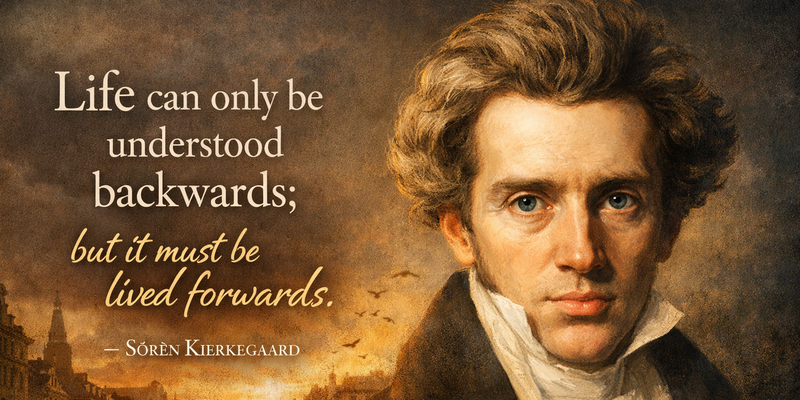

Few lines capture the human condition as sharply as this reflection by Danish philosopher Soren Kierkegaard. Written in the 19th century, it continues to resonate in an age obsessed with planning, optimization, and hindsight analysis. The sentence is simple. Its implications are not.
Understanding through hindsight
Kierkegaard’s insight begins with a quiet truth: clarity often comes too late. We understand our choices, relationships, mistakes, and turning points only after they have unfolded. Patterns reveal themselves in retrospect. Regrets sharpen lessons. Successes appear less accidental than they once felt.
For Kierkegaard, this backward understanding was not merely psychological but existential. He believed that human life cannot be reduced to neat systems or formulas. Unlike the grand philosophical systems of his time, which sought universal explanations for existence, Kierkegaard focused on the individual. Meaning, he argued, is personal, subjective, and often discovered only when we look back.
In modern terms, it is the difference between data and experience. We can collect information, analyze trends, and plan meticulously. Yet the lived reality of a decision — whether it is choosing a career, committing to a partner, or taking a risk becomes intelligible only once we have moved through it.
Living without guarantees
The second half of the quote is where its tension lies: life must be lived forwards. There is no rehearsal, no full preview, no guaranteed certainty. We act without complete understanding.
This forward movement demands what Kierkegaard famously called a “leap of faith.” Importantly, he did not mean blind optimism. He meant courage in the face of uncertainty. To live is to commit — to choices, to beliefs, to paths without waiting for total clarity.
In a culture that prizes certainty and measurable outcomes, this philosophy feels both uncomfortable and liberating. It challenges the idea that we can plan our way into perfect lives. It accepts anxiety as part of being human. In fact, Kierkegaard viewed anxiety not as a flaw but as evidence of freedom. We feel anxious because we can choose.
This is why his work is often seen as laying the foundation for existentialism. Later thinkers such as Jean-Paul Sartre and Friedrich Nietzsche would expand on themes of freedom, responsibility, and individual meaning. But Kierkegaard’s contribution was deeply personal: he wrote not to build systems, but to provoke self-reflection.
A philosophy for modern lives
Today, Kierkegaard’s line reads like quiet advice in an era of constant retrospection. Social media timelines curate our past. Productivity culture pushes us to engineer our futures. Yet neither guarantees understanding in advance.
His words remind us that confusion is not failure. Not knowing is not incompetence. We are meant to move forward without the full map. Understanding will follow, slowly, imperfectly, and often unexpectedly.
Perhaps that is the deeper comfort in his statement. Life’s coherence is not visible in real time. It emerges in reflection. We cannot live backwards to test our decisions first. We can only live forwards, trusting that meaning will reveal itself when we pause and look behind.
In that tension between action and understanding, Kierkegaard located the drama of being human — and left us with a sentence that continues to illuminate it.
Discover more from News Link360
Subscribe to get the latest posts sent to your email.