
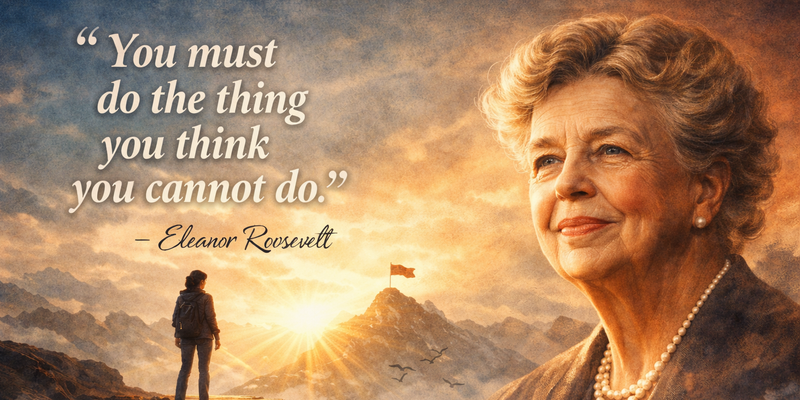

Her words are not about reckless ambition. They are about disciplined exposure to discomfort.
Fear as a compass, not a barrier
Most people interpret fear as a stop sign. Roosevelt’s framing turns it into a compass. The very thing that feels out of reach often signals growth: public speaking for the introvert, entrepreneurship for the risk-averse, leadership for the self-doubting.
Psychologists describe this as exposure. When individuals repeatedly face manageable challenges, their tolerance for uncertainty increases. Confidence, then, is rarely a starting point. It is an outcome.
Roosevelt embodied this principle long before it was formalised in behavioural science. As First Lady during the Great Depression and the Second World War, she travelled extensively, visited coal mines, wrote daily columns, and addressed controversial issues including racial discrimination. Many of these acts were politically risky. Yet each decision expanded both her influence and her resilience.
Courage as a practice
The quote does not suggest dramatic leaps. It suggests intentional action.
Doing “the thing you think you cannot do” may begin with a small step: applying for a role you feel underqualified for, initiating a difficult conversation, or publishing work that exposes your thinking to scrutiny. The discomfort does not disappear; it becomes familiar.
In professional settings, this principle separates stagnation from progress. Organisations that innovate often encourage calculated risk-taking, not because failure is desirable, but because avoidance guarantees irrelevance. On an individual level, avoiding difficult tasks can protect short-term comfort while quietly eroding long-term potential.
Roosevelt’s own life illustrates this trajectory. Widowed at a relatively young age and navigating intense public scrutiny, she continued to write, lecture, and advocate globally. Her authority did not stem from certainty. It grew from action.
Beyond inspiration
Quotations endure because they compress lived experience into a sentence. Roosevelt’s line remains relevant because fear has not disappeared from modern life. If anything, visibility, competition, and rapid change have amplified it.
Yet the logic remains steady: growth requires friction. Skill requires repetition. Leadership requires exposure. The gap between perceived limitation and actual capability is often bridged only through experience.
To do the thing you think you cannot do is not to deny fear. It is to act alongside it. Roosevelt’s legacy suggests that courage is less about temperament and more about habit. Each deliberate step into uncertainty expands the boundary of what feels possible.
In that sense, the quote is less a rallying cry and more a practical instruction. Growth is rarely comfortable. But it is rarely accidental either.
Discover more from News Link360
Subscribe to get the latest posts sent to your email.