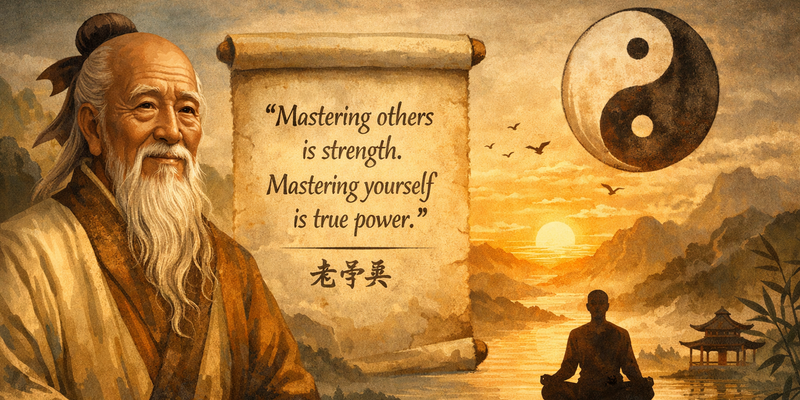
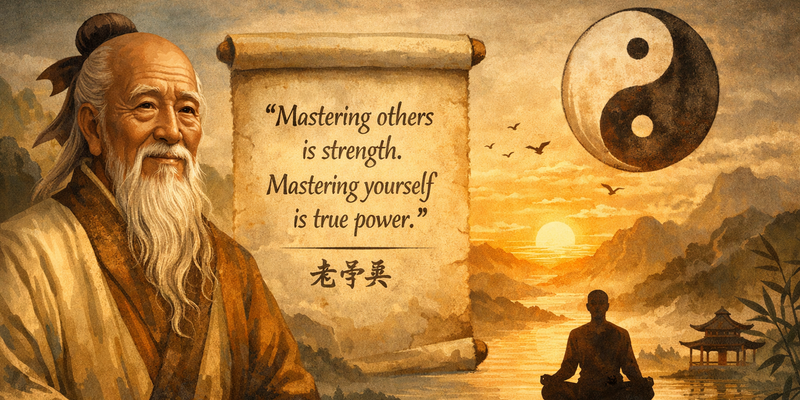

Lao Tzu, believed to have lived during the 6th century BCE in ancient China, is traditionally regarded as the founder of Taoism and the author of the Tao Te Ching. Though historians debate the exact details of his life, his philosophy has endured across dynasties, borders and belief systems. His teachings focus on harmony, balance and alignment with the Tao, often translated as “the Way” — the underlying natural order of the universe.
Strength versus power: A philosophical distinction
At first glance, strength and power appear synonymous. Yet Lao Tzu separates them with precision. “Mastering others is strength” acknowledges the ability to influence, lead or control external forces. This kind of strength is visible — it wins battles, builds empires and commands attention. However, it is often temporary and dependent on circumstances.
“Mastering yourself is true power,” he writes, shifting the lens inward. Self-mastery involves emotional regulation, clarity of thought and restraint in moments of provocation. It demands awareness of ego, fear and desire. Unlike external strength, which relies on control over others, true power requires internal discipline. It cannot be taken away by shifting political tides or public opinion.
In today’s hyperconnected environment, the distinction is sharper than ever. Social media rewards loud authority and instant reaction. Leadership is frequently equated with dominance. Yet organisations increasingly value emotional intelligence, resilience and adaptability — qualities rooted in self-mastery rather than control.
The Taoist approach to leadership
Taoism advocates “wu wei,” often translated as effortless action or action through non-force. Rather than pushing aggressively against obstacles, Taoist philosophy encourages flowing around them, much like water adapting to the shape of its container. Water, Lao Tzu suggests, is both soft and unstoppable — yielding yet persistent.
Applied to leadership, this philosophy promotes humility over ego. A self-mastered leader does not rule through fear but through calm presence. They listen more than they speak. They respond rather than react. Their authority stems from internal stability rather than external assertion.
This perspective challenges modern definitions of ambition. Instead of constant striving, Taoism emphasises alignment — aligning actions with natural rhythms and personal integrity. In professional settings, this can translate to sustainable decision-making, mindful communication and strategic patience.
Why Lao Tzu still matters
Centuries after the Tao Te Ching was written, its insights continue to resonate across cultures. From corporate boardrooms to mindfulness movements, the idea that inner discipline surpasses outward dominance has gained renewed attention. Neuroscience today echoes what Lao Tzu articulated poetically: emotional regulation and self-awareness underpin effective leadership and long-term success.
The philosopher’s enduring relevance lies in his simplicity. Power, he suggests, is not loud. It is steady. It is not about overpowering the world, but about understanding oneself within it.
In an age that glorifies control, Lao Tzu offers a quieter metric of success. Mastery over others may earn applause. Mastery over oneself builds something far more durable — character.
Discover more from News Link360
Subscribe to get the latest posts sent to your email.