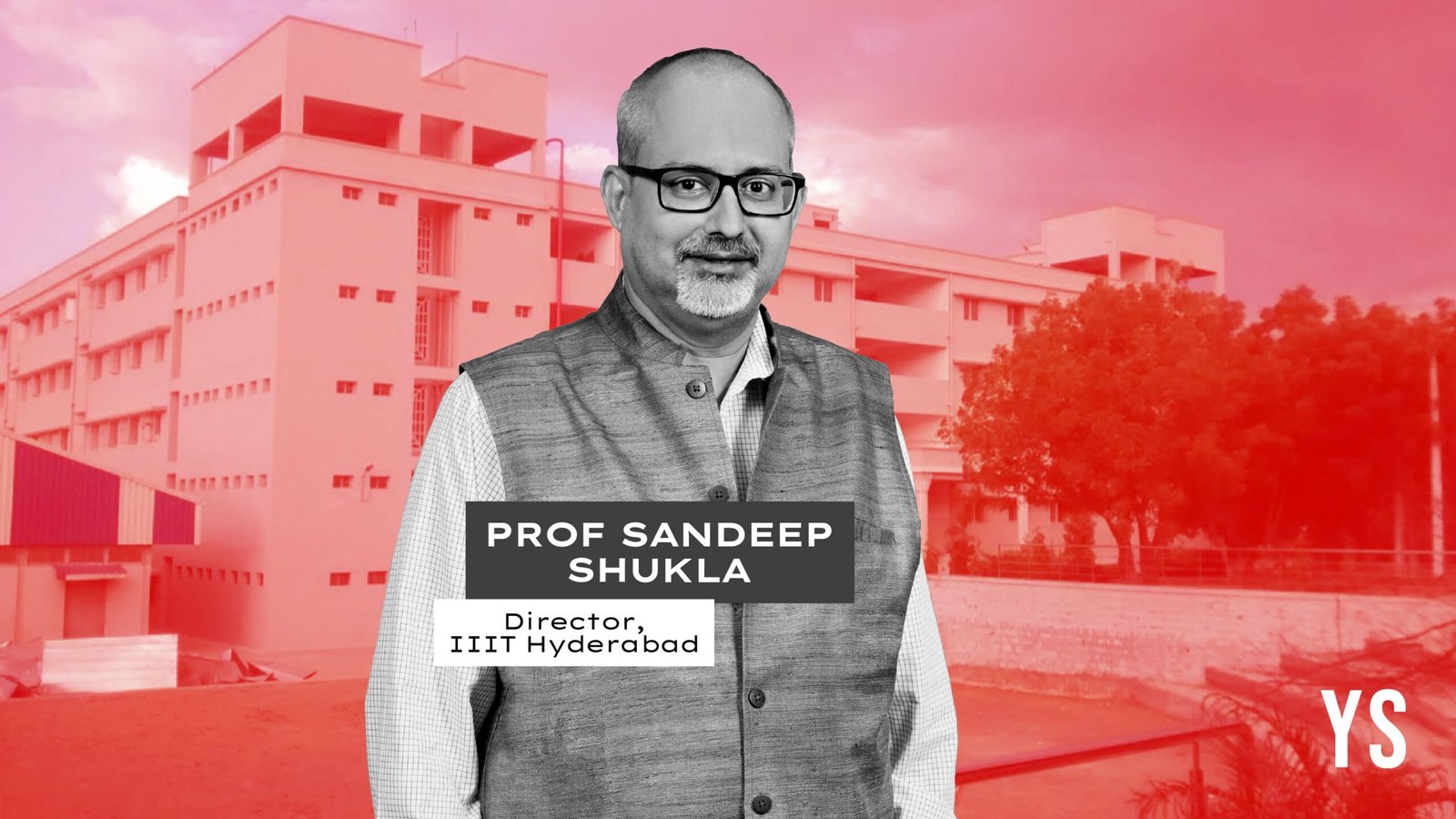
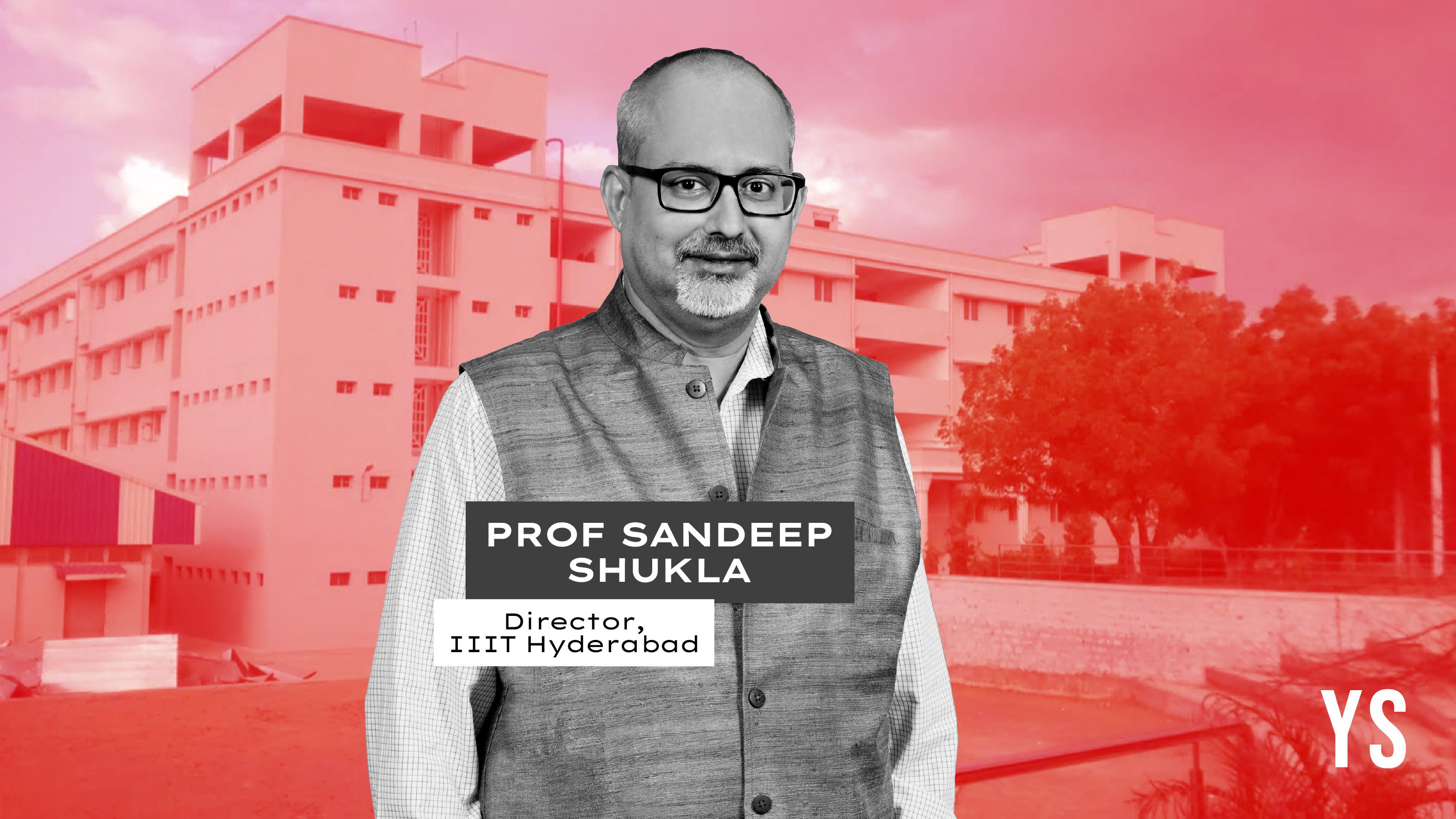

Professor Sandeep Kumar Shukla, Director at IIIT Hyderabad says this obsession on high salaries may distort the country’s long-term prospects, as many of the brightest minds in the country continue to focus on higher salaries from foreign multinational corporations.
He adds that Indian technical education is now at a crucial turning point. With rapid advancement of artificial intelligence (AI) and shifting global dynamics, Professor Shukla believes the system needs a fundamental reset.
Moving beyond the MNC service mindset is not merely a career choice but essential for India’s long-term economic resilience and for giving graduates sustainable and meaningful career paths, he says.
In an interview with YourStory, the IIIT Hyderabad Director explains that to navigate this new era, India must address shifting student values, re-evaluate the gap between education and skilling, and reform an academic ecosystem that has long prioritised foreign publications over solving local problems.
Resilient future
The move away from a service-orientated outlook begins with addressing what Professor Shukla calls a crisis in student mindset, where success is measured mainly by pay. The obsession with crore-plus packages has reshaped the ambitions of students and parents, even though such jobs are rare and usually based outside India, he says.
“Reasonably good students become demoralised because they did not get a two or three crore package. They should be happy to have secured a job in the current market,” the professor notes.
When students compare themselves to these unrealistic benchmarks, they often feel discouraged and less confident. Professor Shukla points to rising mental health problems in top institutes, noting that hyper-competition and unrealistic expectations are contributing factors.
The professor calls for a return to a swadeshi or service-orientated mindset that focuses on contributing to the grassroots economy rather than seeking the highest possible pay cheque from an investment bank.
“The students are thinking only in terms of what an investment bank can give them, rather than what they can do for the grassroots economy. Without strengthening the grassroots economy, India will not progress,” he says.
He suggests that the present generation must rethink inherited definitions of success and avoid measuring self-worth purely through global salary benchmarks. Instead, education should focus on creating responsible citizens capable of withstanding life’s challenges.
IIIT Hyderabad has tried to respond structurally by operating through research centres that connect students to labs and interdisciplinary teams early in their academic journey. The institute runs a product lab, an active Centre for Innovation and Entrepreneurship, and a compulsory two-semester value-education course aimed at broadening students’ perspectives beyond salary metrics.
The institute is also planning a dedicated career-counselling vertical to encourage students to consider research, public service, and entrepreneurship alongside corporate placements.
<figure class="image embed" contenteditable="false" data-id="590965" data-url="https://images.yourstory.com/cs/2/d99b1110116911ed9e63f54395117598/IIITInfographicsResearchCenters-1771996707565.jpg" data-alt="IIIT-Hyderabad" data-caption="
Design: Nihar Apte
” align=”center”> Design: Nihar Apte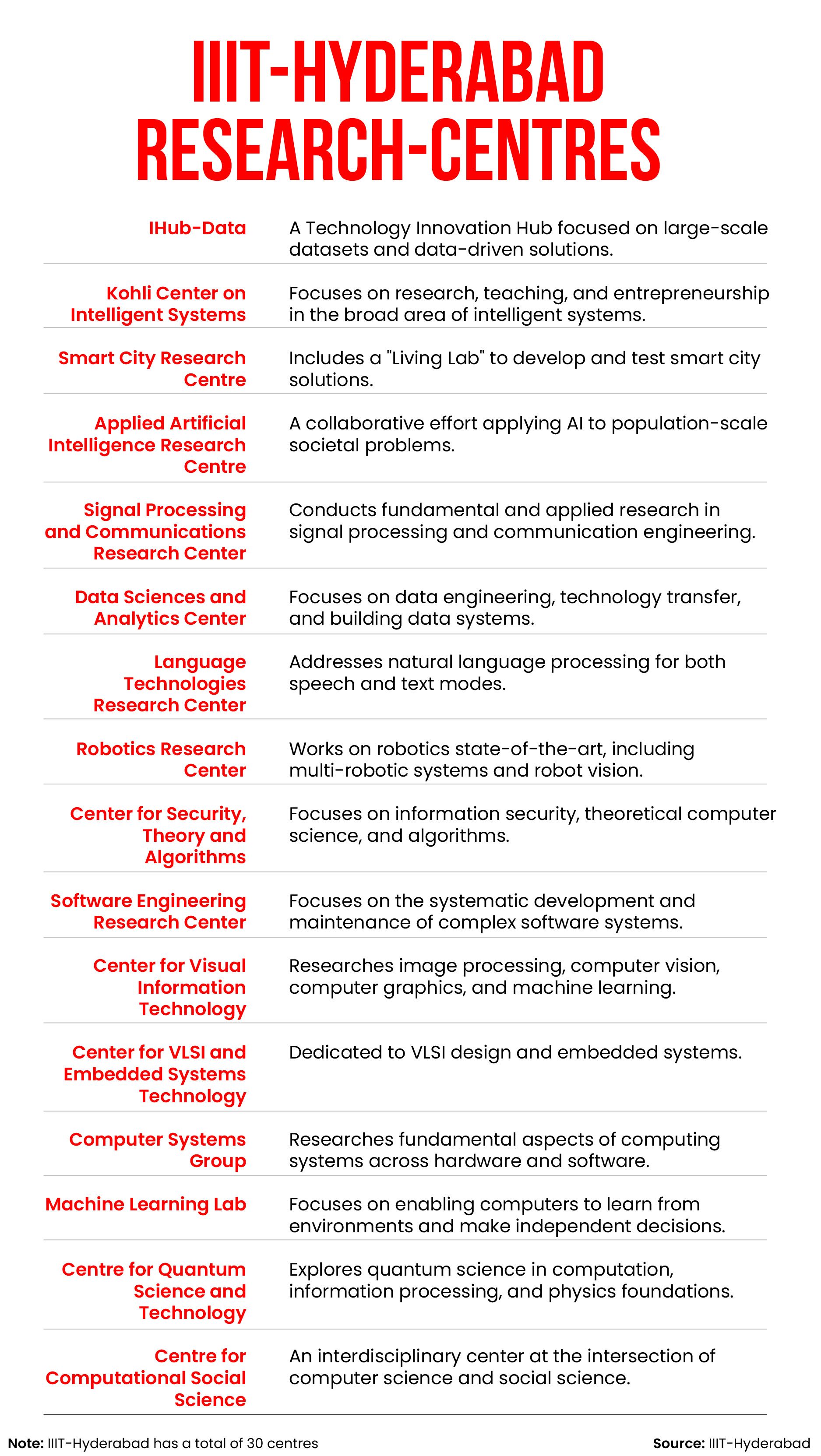
Skilling divide
As generative AI continues to evolve, the distinction between narrow skilling and true education has become more important. Many students and institutions have fallen into what Professor Shukla calls an AI-ML trap, chasing trendy software skills that may quickly become obsolete as reasoning systems and automated code generation improve.
While online programmes are effective for targeted technical skills, particularly for working professionals seeking to upskill, they cannot replace foundational undergraduate education that builds critical thinking, leadership, and the ability to work in multidisciplinary teams, he says.
“If you are already working and need to learn AI or machine learning, an online master’s programme can be very useful,” he adds.
The future workforce will depend on transferable skills that allow graduates to adapt alongside technological change.
“We need students with transferable and soft skills alongside a strong technological foundation, so that they can evolve as technology changes,” the professor notes.
To prepare students for careers that may span four decades, he believes that institutions must teach them how to learn rather than how to use a specific tool or framework.
“We want students who can learn rapidly as technologies change and who can work effectively in large teams,” Professor Shukla says on the transient nature of technical training.
He adds that IIIT Hyderabad is strengthening work in core technology areas such as VLSI and microprocessor systems in partnership with industry and nearby fabrication facilities, arguing that long-term capability in hardware design requires sustained institutional commitment rather than short-term skilling cycles.
VLSI, or very large-scale integration, is the process of embedding thousands to billions of transistors onto a single silicon chip to create integrated circuits.
“Education is necessary and skilling is also necessary, but they have their own places. If we reduce education to mere skilling, we will not create good future employees or good citizens,” he says.
<figure class="image embed" contenteditable="false" data-id="590967" data-url="https://images.yourstory.com/cs/2/d99b1110116911ed9e63f54395117598/IIITInfographicsSnapshot-1771996860264.jpg" data-alt="IIIT-Hyderabad" data-caption="
Design: Nihar Apte
” align=”center”> Design: Nihar Apte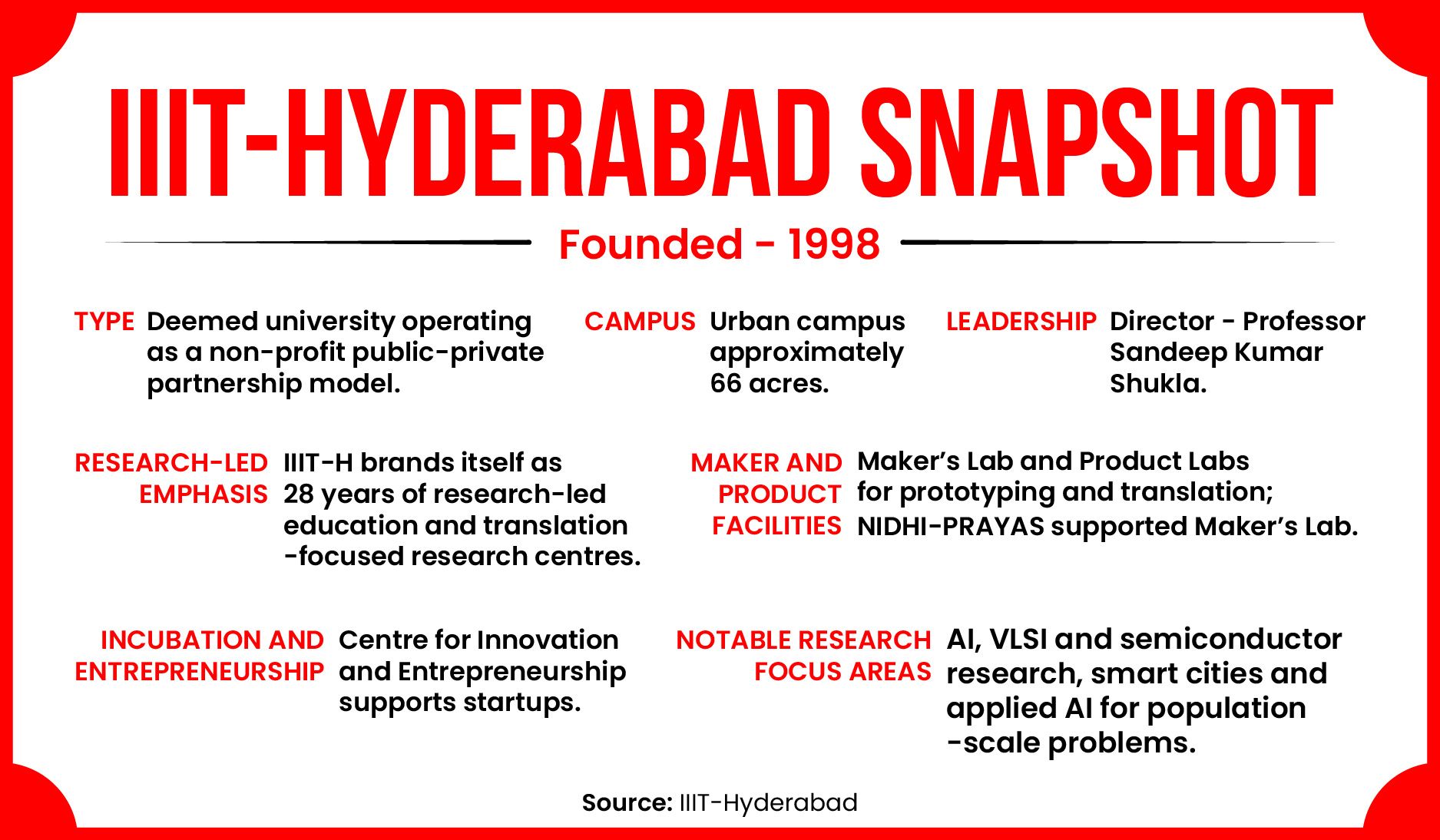
Academic reform
Correcting these issues requires structural reform of the academic ecosystem, starting with how faculty members are evaluated and rewarded. The current system often mirrors American standards by incentivising publications in foreign journals, sometimes addressing problems that may have limited relevance to Indian contexts, explains Professor Shukla.
He argues that institutional reward systems should place greater emphasis on entrepreneurship, industry collaboration, and real-world problem solving.
He also points to developments in China, where some universities allow students to earn degrees by building a startup instead of writing journal papers, provided the technology is translated into real impact.
The professor also calls for leading institutes to mentor private and state colleges by helping train teachers, modernise core engineering curricula, and share research and industry networks.
“The IITs should be assigned responsibility for mentoring a large number of local colleges – conducting teacher training and helping build curricula that prepare students for the future,” he says.
According to him, this broader engagement is essential if the majority of graduates across the country are to remain relevant in a rapidly-changing technological environment.
Institutions must also develop thoughtful AI policies that move beyond knee-jerk bans. For instance, using AI productively for personalised homework, personalised feedback, and better learning support.
<figure class="image embed" contenteditable="false" data-id="590966" data-url="https://images.yourstory.com/cs/2/d99b1110116911ed9e63f54395117598/IIITInfographicsImpact-1771996793524.jpg" data-alt="IIIT-Hyderabad" data-caption="
Design: Nihar Apte
” align=”center”> Design: Nihar Apte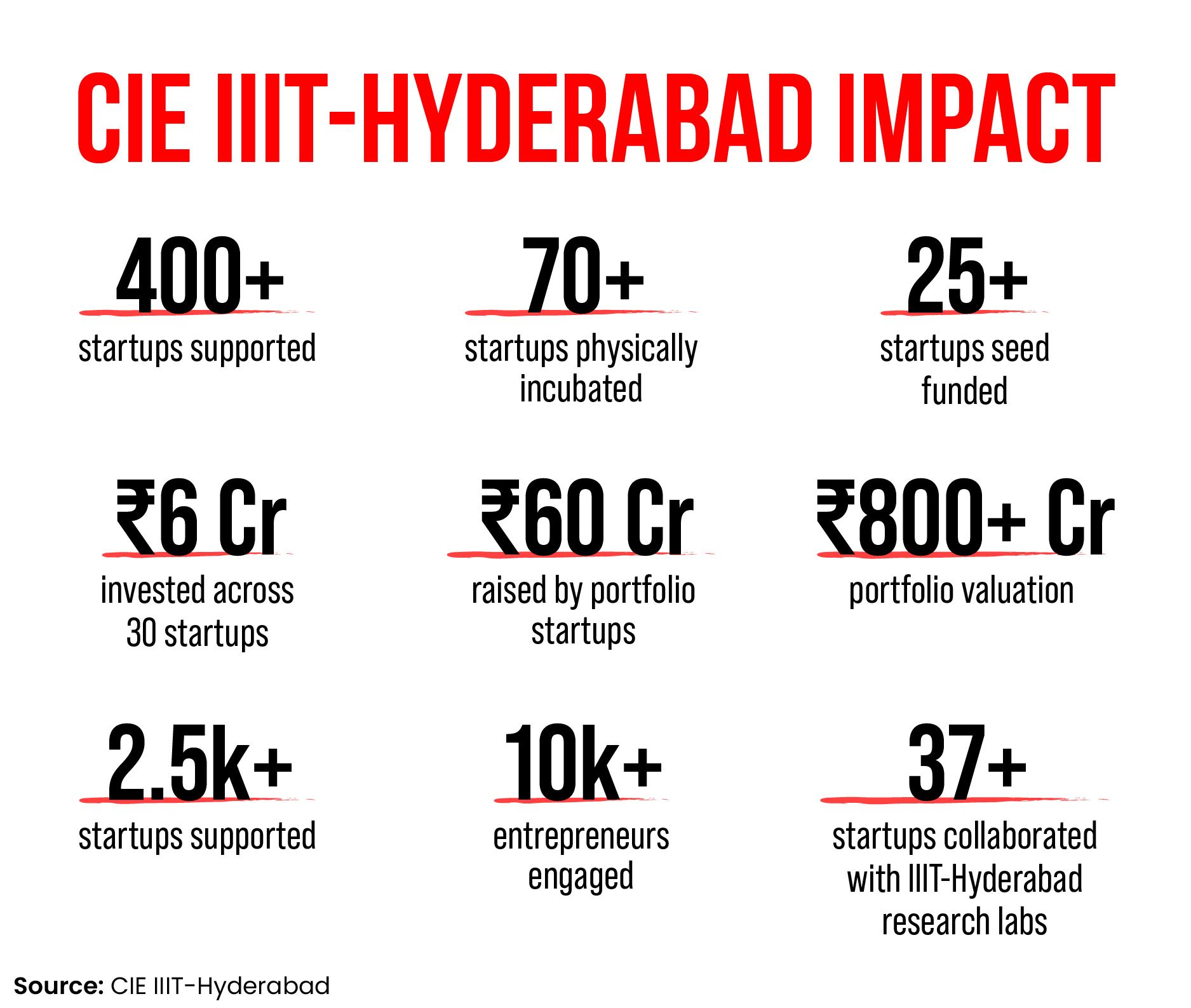
Barriers to innovation
Even when students are encouraged to innovate, the larger ecosystem can present obstacles. Although India has fostered over a lakh startups in recent years, many of them are concentrated in the service sector rather than in deeptech product development.
Professor Shukla says that product-based startups, particularly in areas such as cyber security, often struggle to scale beyond proof-of-concept.
Drawing on his experience mentoring startups at a cyber security innovation hub earlier in his career, he says many young firms secure pilot projects but fail to convert them into large procurement orders because public sector and government systems rarely prioritise emerging domestic products.
“When products emerge from Indian startups, very few institutions are willing to give them a chance. Many buyers default to established multinational vendors,” the professor adds.
Without a clear pathway to sustained customer adoption and revenue, it remains difficult to persuade top graduates to choose entrepreneurship over stable corporate roles. Also, many graduates from top institutes feel they have already achieved success upon securing high-paying placements and may be reluctant to assume the financial and reputational risks associated with building companies.
For Professor Shukla, this reluctance to take risks reflects a deeper shift in how engineering education has come to define success. If institutions prioritise placements and pay packages over character, responsibility, and public purpose, graduates will continue to optimise for career security rather than impact.
“Colleges should create proper citizens and responsible human beings, and everything else will follow. Instead, we began to think that engineering colleges exist only for skills training, and that is where we went wrong,” he says.
(Cover image and infographics designed by Nihar Apte)
Edited by Megha Reddy
Discover more from News Link360
Subscribe to get the latest posts sent to your email.