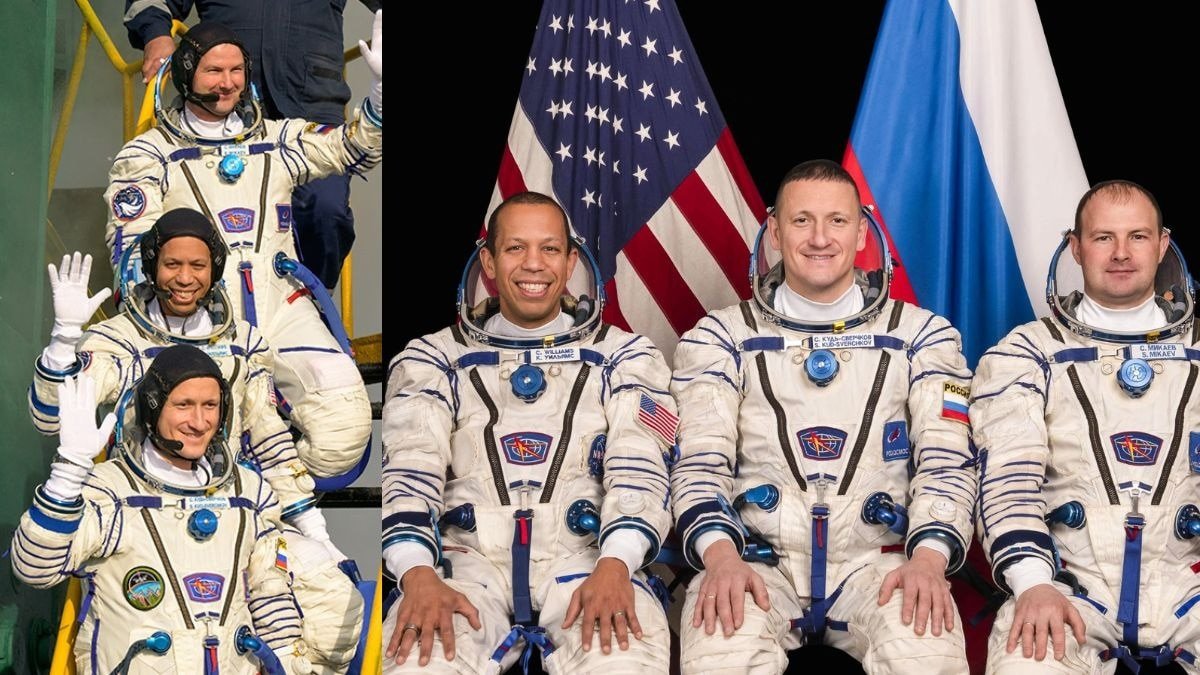
The Nasa astronaut and his two Roscosmos crewmates, Sergey Kud-Sverchkov and Sergei Mikaev, are due to thud down on the flat grassland of Kazakhstan, southeast of Dzhezkazgan, at about 3.55 pm IST, aboard the Soyuz MS-28 capsule.
All three launched together from Baikonur on November 27, 2025, and all three come home after the same 241 days, 3,856 orbits and more than 102 million miles.
WHO ARE THE THREE CREW MEMBERS COMING HOME?
Kud-Sverchkov, on his second flight, commanded the station as head of Expedition 74 before handing over to Nasa astronaut Jessica Meir on Saturday. For Mikaev, a flight engineer, it was a first trip to orbit, as it was for Williams.
In May, the two cosmonauts spent six hours outside the station in Russian Orlan spacesuits, fitting an instrument to measure solar radiation and stripping older physics and microbiology experiments from the hull.
Across eight months, the trio kept the laboratory running and supported research on how bodies, cells and materials behave once gravity is removed.
WHY IS RETURNING FROM SPACE SO DANGEROUS?
The station races around the planet at roughly 28,000 kmph. To fall out of orbit, the crew must lose speed, not gain it. The capsule fires its engine against its direction of travel, a manoeuvre called the de-orbit burn, trimming its speed by barely more than 100 metres per second.
That tiny nudge lets Earth’s gravity reel it in. Moments before re-entry, the Soyuz sheds two of its three sections. Only the bell-shaped descent module, carrying the crew, is built to survive. The rest burns away.
WHAT MAKES A RETURNING CAPSULE GLOW LIKE A METEOR?
Most people assume the fire of re-entry is friction. It is not. The capsule moves so fast that it crushes the air in front of it, and squeezing a gas heats it violently. This wall of compressed air, called plasma, which is simply gas so hot that its atoms have been ripped apart, reaches 1,500 to 2,000 degrees Celsius.
A sacrificial layer on the base, an ablative heat shield, protects the crew by charring and flaking away, carrying the heat off with it. The same plasma blocks radio signals for a few minutes, the famous communications blackout, which is entirely normal.
WHY CANNOT ASTRONAUTS SIMPLY WALK OUT?
During the plunge the crew feels four to five times their body weight. Near the ground, a small drogue parachute steadies the capsule before a huge main canopy opens, and one metre up, small rockets fire downward to cushion the blow. Even so, astronauts liken the landing to a car crash.
The greater ordeal is gravity itself. After eight months of weightlessness, bones thin by one to two per cent a month and muscles waste, despite two hours of daily exercise. Blood that pooled in the chest drops to the legs, leaving many too dizzy to stand.
Recovery teams will lift each crew member out, run quick checks, and fly them by helicopter to Karaganda. Williams then heads to Nasa’s Johnson Space Center in Houston, while Kud-Sverchkov and Mikaev return to Star City. The science of falling home has rarely looked so brutal, or so beautiful.
– Ends
Discover more from News Link360
Subscribe to get the latest posts sent to your email.