
This Hyderabad startup is simplifying metabolic health with a pocket-sized, non-invasive device
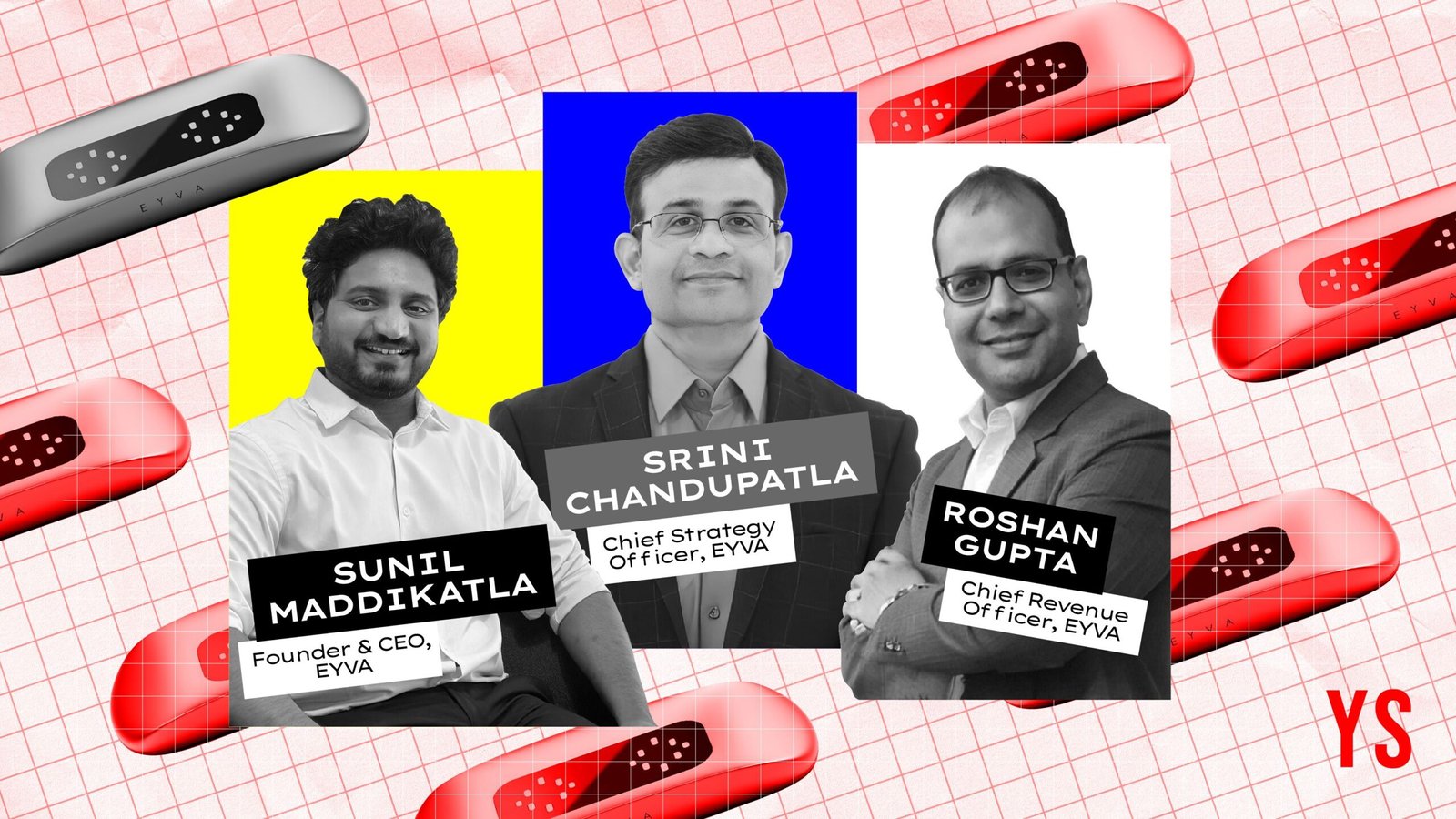
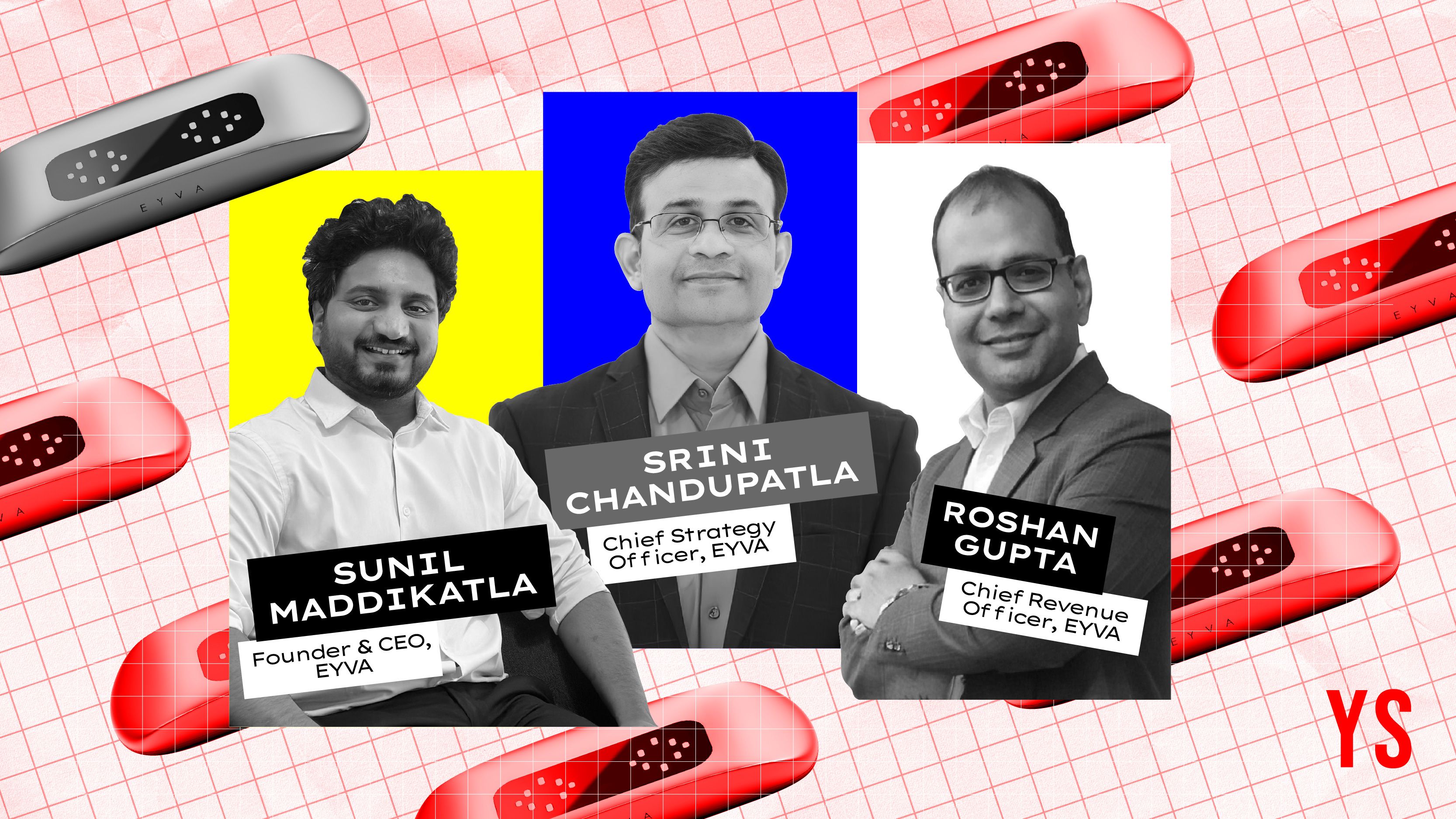

“People alienate their health because everything around it is super-complicated,” says Sunil Maddikatla, Co-founder,
This gap between everyday wellness needs and accessible health monitoring inspired Hyderabad-based Maddikatla to develop EYVA, a pocket-sized, non-invasive metabolic health device, under its parent company, BlueSemi.
The startup blends biosensing with AI to give users personalised insights into glucose stability, blood pressure, oxygen levels, heart rhythm, metabolic score, and long-term trends.
Maddikatla formally launched the company in 2017, along with Roshan Gupta (Chief Revenue Officer), Srini Chandupatla (Chief Strategy Officer). The three have known each other for over a decade through mutual friends.
Over the years, they observed a silent rise in metabolic conditions across India. “One in three Indians is monomaniacally obese. They don’t look obese, but visceral fat builds up, leading to insulin resistance, low metabolic functions, fatigue, dizziness,” Maddikatla tells YourStory.
Most people attempt to address these issues by hitting the gym or tracking heart rate alone, but Maddikatla says they were “fixing it at the wrong place”.
Maddikatla brings over 15 years of experience in health and wellness sectors. He previously worked as a consultant with a UK-based company that was later acquired by Abbott. He then continued his MS research in Analog VLSI at IIIT Hyderabad till 2016.
Building a non-invasive metabolic gadget
It took nearly five years for research and development before the commercialisation of EYVA. The team launched the prototype at CES Las Vegas in 2022, followed by alpha and beta launches before finally going live in mid-2023. Today, the device has about 20,000 users, with nearly 3,500 people using it daily for six to nine minutes.
The health tracker measures glucose stability, blood pressure, oxygen levels, heart rhythm, and metabolic history. “You just switch it on and place your fingers. In less than 60 seconds, it shows all the data,” Maddikatla says.
The paid app, EYVA, available on Android and iOS, uses AI to hyper-personalise insights. “It takes around 30 initial scans to understand you, your physiological, biological, and behavioural data,” he says. Each suggestion is customised, whether it is asking users to improve hydration or recommending evening workouts based on AQI and seasonal variations.
“EYVA is built for trends, but even then, it matches 85% accuracy when compared with WHO gold-standard machines used for manual testing,” Maddikatla tells YourStory.
The app uses neural networks for scoring and combines GPT, Gemini, and Claude-based generative models with strict in-house guardrails.
.thumbnailWrapper{
width:6.62rem !important;
}
.alsoReadTitleImage{
min-width: 81px !important;
min-height: 81px !important;
}
.alsoReadMainTitleText{
font-size: 14px !important;
line-height: 20px !important;
}
.alsoReadHeadText{
font-size: 24px !important;
line-height: 20px !important;
}
}

Designed and manufactured in India
EYVA devices are fully made in India; they are 99% recyclable, and the device is made from strong anodised aluminium, similar to the material used in high-end laptops and phones.
Maddikatla says, “Even if people take a screw and try etching, nothing happens. You let it fall from the first floor, nothing happens.”
The device is FDA-registered and also registered under India’s MDR–CDSCO regulations, meeting the basic compliance required for health-monitoring devices.
Designed in-house, the device is manufactured through 15+ contract partners across Bengaluru, Hyderabad, and other locations. Following its 2012 unveiling, the startup’s first paying users came from a large waiting list of 7,000 people. Early adopters included diplomats, bureaucrats, professionals, and celebrities from India, the US, and Singapore.
With Indian families in mind, each device, priced at Rs 16,650, supports four user profiles. This helps households avoid buying multiple units.
EYVA is sold only on its website and app, a deliberate choice to stay close to early adopters. “A technology like this is first in the world. We wanted to understand every gap,” the founder says.
Each purchase comes with 1.5 years of unlimited app access. EYVA will soon introduce advanced optional features, which users can choose to unlock for up to $1 annually in India, keeping the barrier low.
Team, operations, and revenue
EYVA has a 25-member core team and about 30 people on extended payroll. The tech team of six works mainly on AI algorithms and electronics. The startup operates across Hyderabad, Delhi, and Ahmedabad.
Delhi handles D2C and customer success, while Ahmedabad oversees quality control and design.
The startup has raised about $3 million so far, reaching up to a pre-Series A round. Investors include family offices and angels from India, the US, and Singapore, with leaders from Samsung and Microsoft among them. The startup’s FY24 revenue was around $25 million, and it claims to have grown 2.5x in FY25 revenue.
.thumbnailWrapper{
width:6.62rem !important;
}
.alsoReadTitleImage{
min-width: 81px !important;
min-height: 81px !important;
}
.alsoReadMainTitleText{
font-size: 14px !important;
line-height: 20px !important;
}
.alsoReadHeadText{
font-size: 24px !important;
line-height: 20px !important;
}
}

Market, competition, and challenges
Challenges in the early years included UI/UX improvements and clarifying the right target audience. EYVA is not intended for Type 1 diabetics, people under 18, or those with HbA1c above 11.
As per Maddikatla, there is no true non-invasive competitor globally. “A Dexcom with an Omron and an Oura have to come together to do something like us,” he says.
Globally, companies integrate multiple devices, but EYVA wants to be a single metabolic health platform.
According to an IMARC Group report, India’s digital health market was pegged at about $14-16 billion in 2024 and is projected to reach roughly 476–107 billion by 2033, growing at a CAGR of about 19-25%.
“We’re aiming to onboard 200,000 users in the next three years,” Maddikatla says.
Expansion and the future
EYVA revealed its product in Australia recently, with the New South Wales Minister for Innovation and Technology showcasing it at the NSW Parliament House in Sydney. It’s planning to launch in Australia and is eyeing the US in the next quarter. The price of the device and subscription plans will vary.
EYVA will soon enter the B2B2C sector in India through corporate wellness partnerships. Internationally, it is exploring B2B2C channels with strong go-to-market partners.
A new prototype is in development. Maddikatla says it will be built for “busy individuals” needing quick, deeper energy insights.
Discover more from News Link360
Subscribe to get the latest posts sent to your email.