



How Sigma University is building an MSME-first startup ecosystem in Gujarat


Yet, despite MSMEs forming the backbone of the economy, most university incubation models remain misaligned with their realities. Generic startup themes, short-term programs, and idea-stage validation often fail to translate into deployable solutions or sustained outcomes on the ground.
Vadodara-based Sigma University is attempting to reframe this narrative through its Sigma Entrepreneurship Development & Incubation Centre (SEDIC), an incubation ecosystem designed around deployable solutions, capital discipline, and regional relevance. The university transitioned from the Sigma Group into a full-fledged university in 2023. While the intent around entrepreneurship remained intact, the move fundamentally changed the scale, structure, and ambition of SEDIC’s operations. Notably, Sigma University is recognized as the first nodal institute in Vadodara, strengthening its role as a regional anchor for startup and MSME-led innovation.
“What the university framework enabled was a change in how SEDIC could operate,” says Hasit Desai, Director – Startup & Incubation, Sigma University. “We moved from running limited programs to building a structured, continuous incubation system with standardised screening, longer incubation cycles, aligned capital deployment, and closer coordination with industry and government schemes.”
From facilitating startups to institutionalizing innovation
As part of Sigma University, SEDIC evolved from being a facilitation layer into an institutional backbone for innovation. The focus shifted to building a repeatable idea-to-PoC pipeline, grounded in execution and accountability. The incubation process is deliberately designed to filter ideas early, starting with idea identification, followed by validation, screening, PoC development, review, and next-stage readiness.
“Most ideas don’t progress beyond the early stages, and that’s intentional,” Desai explains. “Early-stage filtering protects capital, sharpens founder thinking, and improves the overall quality of the ecosystem.”
Over the last two years, SEDIC has built a 100+ idea-to-PoC pipeline, prioritizing learning velocity and execution readiness over vanity metrics.
Sigma University positions itself as a career-first university, with a strong academic foundation across pharmacy, physiotherapy, nursing, engineering, commerce and management, design, hotel management, and science.
Active MoUs with industry partners such as VFS, Zydex, Fairmate, Virohan, Jindal School, TrueFalse & Free Bird, GII, among others, ensure students gain hands-on exposure through internships, live projects, and applied innovation. Rather than chasing headline numbers on placement-linked exposure, SEDIC focuses on depth.
“Industry exposure has to be structural, not an add-on,” Desai says. “Students who engage with incubation experience real-world evaluation, execution milestones, and accountability – conditions that mirror actual industry environments.”
Putting real capital behind entrepreneurship
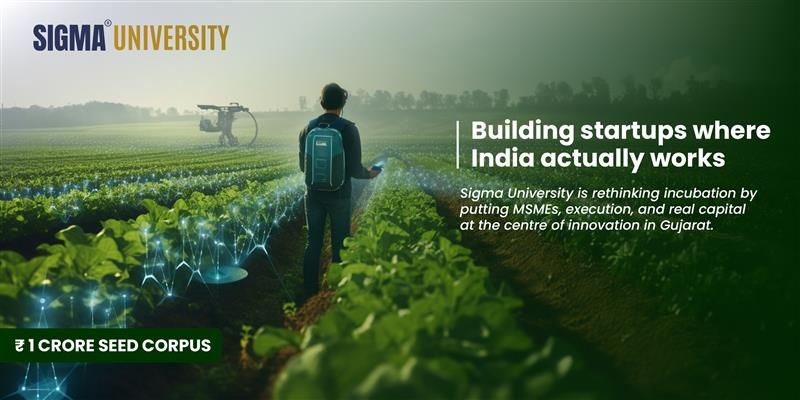
While many academic institutions talk about entrepreneurship, few deploy early-stage capital. Sigma University committed a Rs 1 crore seed corpus, aggregating CSR capital, Startup India Seed Fund Scheme (SISFS) support, and SSIP (Government of Gujarat) allocations.
So far, Rs 92 lakh+ has been deployed under SISFS, Rs 84 lakh+ mobilized through CSR-backed initiatives with Shaily Plastic Engineering, and Rs 25 lakh+ mobilized through SSIP as a nodal institute. “Access to real capital anchors entrepreneurship in execution,” Desai notes. “It shifts the ecosystem from discussion to decision-making, without compromising governance.”
Rather than measuring success purely through early revenue, SEDIC tracks execution readiness: movement from idea to PoC, pilot preparation, and founder capability.
Why MSME-first innovation matters
SEDIC’s focus on MSME-first innovation stems from regional reality. Central Gujarat’s economy is driven by manufacturing, processing, and services-led MSMEs, making broad, generic startup themes difficult to validate on ground.
“Innovation that ignores regional context struggles with adoption,” Desai explains. “An MSME-first approach ensures faster feedback loops, real operational challenges, and clearer pathways to impact.”
This grounding has also shaped SEDIC’s approach to CSR partnerships. Instead of symbolic funding, industry partners participate directly in screening and decision-making. “Shared governance is key,” he says. “Partners like Shaily were involved at every stage, ensuring capital was deployed through joint conviction rather than isolated initiatives.”
NOVA: testing execution, not just ideas
SEDIC’s flagship platform, NOVA, was designed to test execution rather than celebrate pitch decks. The first edition drew over 450 applications, from which 90+ startups were shortlisted. These teams went on to deliver 70+ live pitches, resulting in 25+ startups receiving funding on stage. The event unlocked over Rs 1 crore in potential investments, along with 26 grants and cheques announced. In addition, 20+ focused mentoring sessions were conducted, and 20+ startups showcased live pilots and real-world use cases, reinforcing NOVA’s emphasis on execution over presentations.
Building on this momentum, ‘NOVA 2.0 – Pitch. Deal. Done’, has been designed as a sharper, outcome-driven edition, with focus clusters chosen deliberately for their relevance and deployability. This year, the spotlight is on applied AI, vertical SaaS, and sustainable engineering, addressing MSME digitalisation, manufacturing, clean-tech, and automation use cases, alongside agritech, rural innovation, and social entrepreneurship, which focus on agriculture value chains, rural livelihoods, and climate resilience.
“NOVA is not a showcase; it’s a validation layer,” Desai says. “Selected teams move into SEDIC’s incubation pipeline post-event, where engagement continues through capital access, pilots, and industry connect.”
Building an ecosystem that outlives events
For Sigma University, incubation is not only an annual highlight but also an operating system. With over 23 years of industry engagement through the Sigma Group, the university is leveraging long-standing MSME relationships to build a startup ecosystem rooted in execution.
“Innovation works only when it’s built into the system,” Desai concludes. “By focusing on groundwork, discipline, and regional relevance, we are building an ecosystem that delivers real, on-ground impact.”
As Sigma University deepens its incubation framework, it is laying the groundwork for a startup ecosystem that mirrors the region it serves: pragmatic, execution-led, and built to last. Central Gujarat’s next generation of founders is set to emerge from systems that demand accountability and convert intent into action.
Discover more from News Link360
Subscribe to get the latest posts sent to your email.