


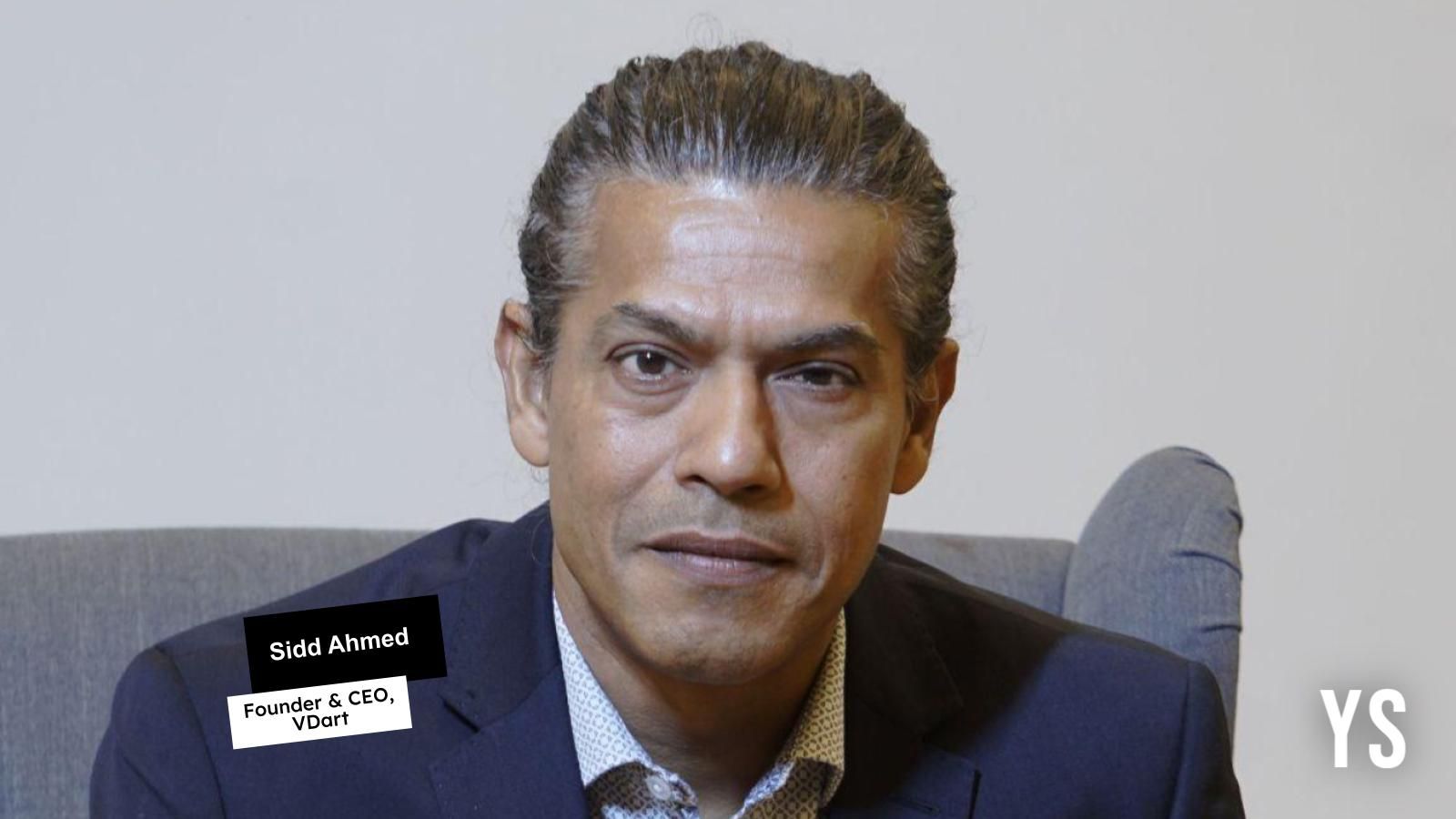
He turned his father’s terrace into a $300M empire, now he wants to help you create yours


But the curious thing about all that running is where it has brought him. Not further away from the small city he left behind, but right back to it.
We met him on a January afternoon at a cafe on Chennai’s East Coast Road, a stone’s throw from Tamil superstar Vijay’s house, talking about Trichy the way some people talk about a first love they never quite got over. In the course of an hour-long conversation, he must have mentioned the city some 50 times—or even more.
“When I go to Bangalore, I feel out of place,” he said, stirring his lemon tea. “When I go to Chennai, I feel out of place. But Trichy is where my home is. When you get there, you feel it.” Then he spread his arms wide as if to demonstrate what he feels once he is in his birthplace. “This is home,” he said, pushing his upturned palms downwards.
That attachment to his hometown is not merely sentimental. It is the cornerstone of everything Sidd Ahmed has built.
From humble beginnings
The story begins in a modest household where his father had studied only till class 10 and worked as a farmer, driver, and various other jobs to keep the family of eight afloat. Trichy, despite being home to nearly a hundred educational institutions, offered precious few employment opportunities. BHEL was the only large employer in town.
“The only thing my parents did, the amazing thing they did, was great parenting and the gift of education,” Sidd recalled. “They made sure all their kids were well educated.”
When his father moved to Bahrain as a driver in 1975, the family’s fortunes began to shift. Sidd became the only one among his siblings to attend an English-medium school. After completing a bachelor’s degree in computer science, he worked at Aptech on Cathedral Road in Chennai before landing a job with a small American firm that flew him to Pittsburgh in 1997.
For the next decade, Sidd worked for various small technology firms in the United States, climbing from a recruiter’s role to commanding a quarter million dollars in salary. But something gnawed at him. Every employer he pitched the idea of setting up operations in Trichy brushed him aside. One wanted Chennai. Another insisted on Hyderabad. Nobody could see what he saw in that temple town on the banks of the Cauvery.
A terrace and a dream
In December 2007, just months before the global financial system would begin its spectacular collapse, Sidd Ahmed quit his job. He had been offered a guaranteed salary of half a million dollars over three years. He turned it down.
He sold his house and his cars in Detroit, moved into a small apartment in Atlanta where his customers were based, and started VDart from his living room with just $500 in hand. The name came to him during a conversation with his wife after 15 minutes of brainstorming. The V stood for “we” because no organisation, he believed, could be built by an individual alone. The “dart” represented speed, the equivalent of dash, a nod to his sprinting days.
In the first year, Sidd was the CEO, the sales team, the recruiter, the HR department, and the finance function, all rolled into one person. He landed three major customers that year, including Genpact, Cognizant, and HCL. It took him 18 months before he could afford to hire his first employee.
By 2010, when the company had grown to a hundred people, he flew to Trichy, met a few close friends, and convinced them to help him set up an India office.
But there was a catch. He could not afford Rs 1.34 lakh for a proper office setup. So they put up an asbestos roof on the terrace of his father’s house and hired five fresh graduates from local colleges.
“We call it a terrace startup,” Sidd laughed. “Motamadi (terrace in Tamil) startup is what we call it.”
Those five employees, barely out of college and working in the sweltering heat of a makeshift terrace office, are today managing portfolios worth $20 to $30 million each. They travel between India and the United States, raise families in Trichy, and have helped build an organisation that has hired over 6,400 freshers in the last 16 years.
The factory that became a tech hub
Within six years, the terrace operation had spilt over into four adjacent residential properties, cramming 450 people into homes that were never designed for office work. The neighbours were understandably annoyed.
Sidd decided VDart needed a proper facility, but he wanted something that would make young engineers from small-town India feel like they had arrived. He wanted it to look like an office in Manhattan, like a five-star hotel.
While scouting for land, he stumbled upon an old manufacturing facility that had fallen into disuse. Trichy had long been a hub for BHEL ancillaries, and this particular building still had lathe machines gathering dust inside. Sidd had seen American companies converting warehouses into sleek IT offices. He knew exactly what to do.
The transformation was meticulous. They brought in staff from the newly Marriott-affiliated Sangam hotel to train their housekeeping teams. The result was a world-class three-floor building that could seat 650 people.
“When I am working in the US, the luxury is what I have working in an office,” Sidd explained. “How can we create the same luxuries for our people in Trichy?”
At its peak, the Trichy facility employed 852 people. Even now, roughly 640 employees continue to work from the heart of Tamil Nadu, supporting operations that span the United States, Canada, Brazil, the United Kingdom, Japan, and beyond.
Building for a hundred years
Today, he runs several verticals beyond staffing. His firms have evolved into a group of six businesses. The core technology consulting arm provides talent to Fortune 500 corporations. VDart Digital handles services and solutions. Vouch, their digital identity platform, serves nearly 20 million consumers in North America. Hidden Curve runs digital marketing campaigns for NFL athletes and celebrities. Verified ID is disrupting the background check industry. And VDart Ventures invests in startups with cheque sizes ranging from $25,000 to $1.5 million.
“Lifestyle does not really matter a lot to me because I know where we came from,” he said. “The goal was always to build an organisation with thousands of employees.”
VDart’s journey from a terrace in Trichy to the pages of Harvard Business Review, where it is now featured as a case study on how a company built with purpose and culture at its core can deliver for Fortune 500 corporations from a tier-two city, is perhaps the most telling vindication of that approach.
The regular guy
As the afternoon wore on, Sidd spoke about what advice he would give to young entrepreneurs. Win the customer first, he said. Build the product after. And never underestimate hustle.
“Integrity is one aspect,” he explained. “But hustle is something very, very important. You can have a lot of integrity and a half-baked idea, but it is not going anywhere if you do not have the drive to push.”
He mentioned Malcolm Gladwell’s Outliers as his favourite book and admitted that he saw himself in those pages, a man whose trajectory defied the odds. He spoke about the junior internship programme he has launched in Trichy to teach entrepreneurship to schoolchildren. Last year, a seven-year-old sat through the entire four-week programme while his father waited patiently each day.
When asked where he finds his strength, Sidd pointed to his family, his running, his morning meditation and journaling. The discipline of waking before dawn, rain or shine, snow or heat, has kept him centred through the myriad demands of running a global business.
“A lot of days, I really do not have the motivation,” he admitted. “It is zero degrees outside and I cannot run. The motivation disappears. But it is just the discipline that takes you through.”
His son once told him he just wanted to be a regular guy when he grew up. The phrase stuck.
“I am the regular guy,” Sidd said with a grin. “Everybody should be able to talk to me. I am just a normal guy.”
But there is nothing normal about what he has accomplished. From a small house in Trichy to a $300 million global enterprise, from a terrace office with five employees to a company that operates across several countries, Sidd Ahmed has proven that you do not need a metro city, a fancy degree, or a venture capitalist’s blessing to build something extraordinary.
All you need is to find your way back home.
Discover more from News Link360
Subscribe to get the latest posts sent to your email.