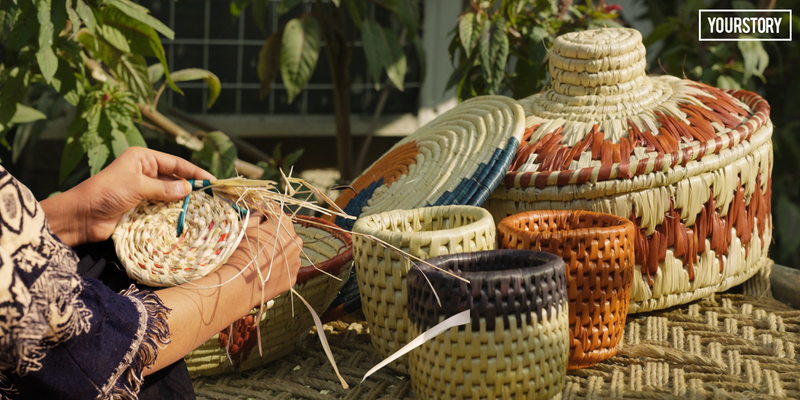
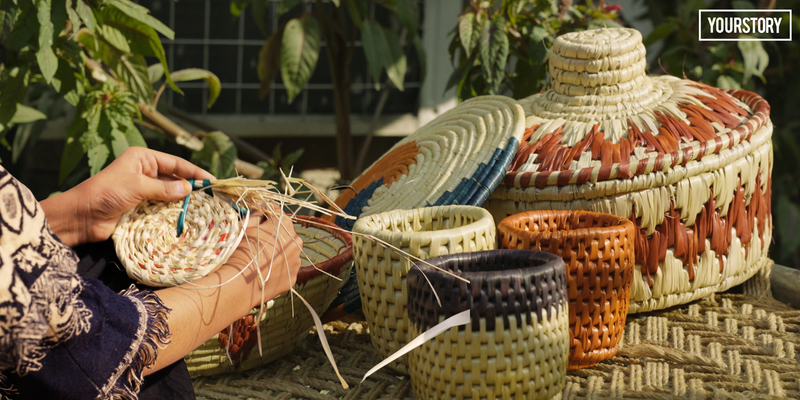

In Prayagraj, Uttar Pradesh, Moonj craft has survived not through factories, but through families. For generations, women in Mahwa village have harvested seasonal Moonj grass, dried and stored it, and transformed it into handwoven, decorative items, coasters, baskets and other utility containers.
Chand, a local artisan, describes the craft as nearly 200 years old in her village. She has been working with Moonj for the past two decades, learning first by watching her sisters and gradually mastering the weaving process herself.
In 2008, she attended a training programme organised by an NGO. After submitting sample products, she was selected for a design development initiative that introduced her to workshops and exhibitions. Since then, she has received a national award and recognition under the One District One Product (ODOP) initiative.
A Craft Rooted in Family History
Chand traces Moonj work back to her grandmother’s time, when women would weave products to fund their own wedding trousseaus. The craft once had export connections as well. Traders regularly collected stock for international markets, but those networks faded over time.
Interest revived around 2017–18 with increased government focus on handicrafts. Today, Chand works with a collective of women artisans to fulfil bulk orders. She credits ODOP for providing design workshops, exposure visits, and toolkits that helped improve finishing and diversify products.
From Seasonal Grass to Market-Ready Products
Moonj grass grows mainly in November and December. It is harvested, sun-dried, and stored for year-round use. Before weaving, the dried grass is soaked in water for 15–20 minutes to restore flexibility.
The weaving begins with forming a base knot known as a “gaad.” A small stick-like tool called a “kaasa” helps maintain structure as the artisan wraps and tightens the grass layer by layer. The process requires minimal tools — primarily a needle, scissors, and water — but demands patience and precision.
A single basket may take an entire day to complete, especially when artisans balance household responsibilities alongside production.
Products include daliyas (baskets), roti containers, and traditional “moni” pieces once used in wedding rituals. With new design inputs, contemporary variations now meet modern market demand.
Chand plans to pass on the craft to her daughter, combining education with skill inheritance. For her, Moonj is not just a product — it is identity, resilience, and livelihood shaped by hands that have woven for generations.
Discover more from News Link360
Subscribe to get the latest posts sent to your email.